


Just as I knew there was no real Gilligan’s Island, I know there is no such thing as the Gulf of America. They are both the figment of someone’s geographical imagination.
One, from the creative mind of a mid-century TV producer named Sherwood Schwartz. The other is from a dim-witted former reality TV star, dangerously detached from reality. Crowning himself King Donald, he renamed the map to suit his ego.
And maps are one thing I know.

Painfully shy in grade school I knew I was never going to be one of the popular girls with Breck shiny hair, and perfect Carnaby Street clothes copied from the pages of their older sister’s Seventeen magazine. The kind of cute girl that both teachers and other kids gravitated to and longed to please.
I resigned myself that I was never going to be the first one picked for volleyball team during gym or the one who would get the most heart-covered Valentines from crew-cut-headed boys on Valentine’s Day.
But there was one thing I knew I excelled at more than all my other classmates. The one thing I would always be picked first to do in class.
Drawing maps.

When it came to illustrating maps of whichever state, county, country, or continent we were studying in social studies, I would be chosen by my teacher to render it on a large poster board to display in front of the classroom.
As the class artist I was used to being called on to draw seasonal decorations and my pastel Easter bunnies, scary Halloween witches, and Mayflower Pilgrims could be silly and fun, but the drawing of maps carried weight.
They depended on complete accuracy.
Even as a child cartographer wielding crayons, I took this assignment seriously.
There was no room for flights of fancy or imagination when it came to maps. The names of cities and towns, hills and harbors had to be precise. Each geographic mountain range, coastline, or body of water, was true to the map.
I wouldn’t dream of renaming the Pacific Ocean after my pet dog labeling it “Prince Ocean” any more than I would think of impulsively re-drawing Canada as the 51st State of America.
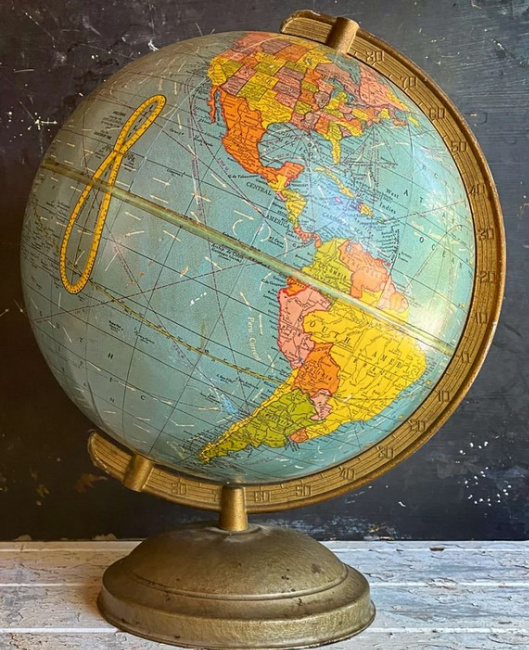
From the time I entered elementary school, the pink wallpaper in my bedroom the one with little prancing lambs and kittens was covered over by a large paper map of the United States.
The map hung over a sturdy wooden desk with a metal globe standing to one side, where I did my homework until I left for college. When my mind would wander as it often did frustrated by arithmetic problems or bored by hanging participles in English class, I would drift over to the map, repeating and memorizing every city, every state capitol, the lakes, rivers, and the gulfs, until could repeat it in my sleep.
Back in the classroom, while other students took turns reading out loud paragraph by paragraph from their textbooks, or eagerly raised their hands to answer questions posed by the teacher, I would be left to myself in my own little world of geography. With school-issued magic markers, crayons, colored pencils, and paint I would carefully recreate maps from the special Teachers Edition of our textbook onto the 27” x 40” stiff white poster board.
It wasn’t just my artistic skills that made me so suited to this task.
My fascination with maps began at a pre-school age.

Colorful maps featured in oversize Atlases that lined our bookshelves at home told a story, took me to far away places, and held my interest more than any Little Golden Book.
While some mothers read Mother Goose stories to their 3-year-old, my mother Betty would often read to me from our Posner Family Tree book.

Tracing the lineage of my Russian-born great grandfather Abraham who came to America via London in 1881, the family tree went back to the 1600s. The written story of this branch of my family was accompanied by faded maps of pre-WWI Europe allowing me to visualize it all.

Maps told a story that words alone couldn’t. I grew to love the sense of history, politics and culture they conveyed. And the permanency of geographic features that withstood all the politics
The names of the great empires and countries recorded on the maps changed as imperialism devolved. The Ottoman Empire, and Austria-Hungary, no longer existed. Persia, Palestine, and Siam all got new names. The massive Russian Empire the homeland of my ancestors became the feared Soviet Union as it gobbled up much of Eastern Europe.
But The Black Sea with its shared borders never changed to the Red Sea when Russia became a Communist party.
Even Stalin understood that.




 Envisioning The American Dream
Maps expand your horizon of life and who you are making it impossible to become self-centered.
LikeLike
That is a perfect way of expressing it. Among all the many things I collect are old Atlas’s and old maps and they are so filled with knowledge and information.
LikeLike
Maps offer all the possible travel routes but I wonder where we go from this moment?
LikeLike
Recently the UN Security Council attempted to decree a Chapter VII ultimatum which dictated that Israel surrender to Hamas in Gaza.
Italy did not support the recent UN Security Council resolution that called for an immediate and permanent ceasefire in Gaza, which was vetoed by the United States. The resolution received 14 votes in favor, with the U.S. casting the only vote against it. The draft resolution was co-sponsored by several countries, but Italy was not listed among those actively supporting the resolution in the context of the recent vote.
These 14 countries Russia, China, France, United Kingdom, Algeria (co-sponsor), Denmark (co-sponsor), Greece (co-sponsor), Guyana (co-sponsor), Pakistan (co-sponsor), Panama (co-sponsor), South Korea (co-sponsor), Sierra Leone (co-sponsor), Slovenia (co-sponsor), and Somalia (co-sponsor) voted to impose a UN Chapter VII dictate upon Israel. Of these countries Algeria and other scamps countries do not even have diplomatic relations with Israel.
Neither Iran nor Sudan have diplomatic relations with Israel. No different than Algeria. Algeria and Turkey have developed a military partnership and cooperation over the years, particularly in the areas of defense and security. This relationship has been strengthened through various agreements and joint military exercises. The relationship is part of a broader strategic partnership that includes economic and political cooperation, with both countries sharing interests in regional stability and security.
Those 14 countries have already repeatedly called for international condemnation of Israel, rabidly support Palestinian terrorism relabeled as “Palestinian rights”. They already engage in public relations propaganda campaigns hostile to Israel. They already support and initiate legal actions against Israel in international courts such as the ICC. These countries have escalated their rhetoric propaganda against Israel. Hamas could never have dug its complex tunnel system without international support. They already promote cultural and academic boycotts of Israel.
These countries throw their support for the Palestinian cause, like whores on street corners sell their wares. They often use stinky rhetoric, to condemn Israeli actions, framing them as oppressive or colonial. Such putrid rhetoric seeks to poison public opinion and mobilize support for Palestinian groups. Numerous solidarity movements around the world that advocate for Palestinian rights; they often align with groups like Hamas, viewing them as legitimate representatives of Palestinian resistance.
Countries without diplomatic relations with Israel compare to corrupt judges that accepts bribes. This objection, seeks to raise critically important questions about the legitimacy and fairness of the recent Chapter VII UN ultimatum which demanded that Israel surrender to Hamas in Gaza. While the analogy of a corrupt judge highlights concerns about bias and fairness, the international system, in point of fact, operates on principles of representation and sovereignty.
The International system operates, so it appears, as something akin to a beauty contest. What defines beauty — not a rational logical concept. Israel demands a change to the International system. It could express its rebuke of the UN, by leaving the UN. The analogy of a corrupt judge suggests that countries without diplomatic relations with Israel, that they lack objective credibility to fairly judge the case heard before the court of international opinion.
This perception of bias, Israel argues, undermines the legitimacy of all UN resolutions or demands made against Israel. Particularly since nations who do not have diplomatic relations with Israel obvious their anti-Israel hostility – politically motivated – rather than based on objective criteria. Chapter VII of the UN Charter allows the Security Council to take action to maintain or restore international peace and security. However, the application of this chapter, like as in the Korean war, especially when it appears to favor one side over another in a conflict, historically expands the local conflict into a far larger international war. The call for Israel to surrender to Hamas, obviously viewed by both the US and Israel as an ultimatum that lacks balance and fairness. Just as China despised the UN Chapter VII ultimatum decreed against North Korea.
The international UN system, indeed based on principles of state sovereignty and representation. However, the effectiveness and fairness of this system both the US and Israel have repeatedly warned and challenged. Especially when certain countries dominate decision-making processes or when resolutions reflect geopolitical interests rather than universal principles of justice.
The idea that Israel should demand changes to the international UN system, this demand reflects the Israeli requirements for a more equitable and fair approach to international relations expressed through public UN diplomacy organs. Leaving the UN perhaps a radical step. But it raises questions about the effectiveness of the international UN system of public diplomacy among nation states in the world community of nations.
The concerns about bias and fairness in the international UN system, particularly regarding Israel, absolutely valid and reflect broader issues of representation and legitimacy. Whether through reforming the UN or reconsidering its participation, Israel’s approach to these challenges will significantly impact its international standing and relationships. The debate over the effectiveness and fairness of the current international system remains a fixed constant, critical issue in global politics.
LikeLike