


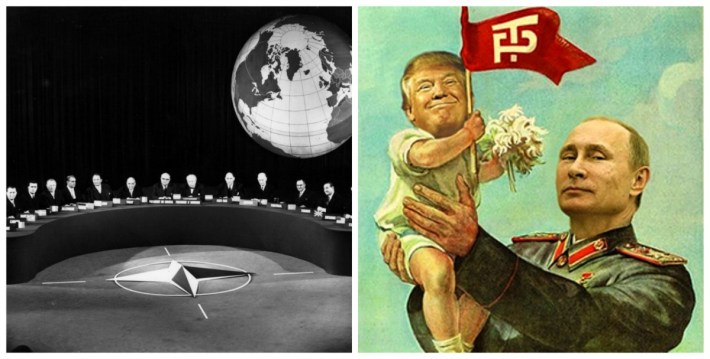
77 years ago, NATO was born in the aftermath of WWII out of a desire to prevent WWIII.
Conceived out of necessity, this enduring alliance was initially forged to prevent Soviet expansionism. The shared democratic values of its members formed a unique bond. An alliance meant to provide reliability in an unreliable world.
For 77 years, Europeans have known that America’s foreign policy and priorities would be consistent with theirs.
Until now
Donald Trump’s broadsides against NATO have rattled this long and formidable military alliance that largely defined the global post-war order. His veiled threats to pull out plays right into Putin’s hands.
From its Cold War inception, Russia has bristled at the formation of NATO, wanting nothing less than a dissolution of the organization. The North Atlantic Treaty was at heart a military alliance intended as a defense against the Russians.
Likely, Trump has never bothered to understand why the partnership was formed in the first place.
All roads lead to Russia.
The Hungry Bear

The fear of Soviet aggression and the spread of communism defined the post-WWII world.
Cast as the Evil Empire during the Cold War, an expansionist Russia was viewed as a “hungry bear” whose insatiable appetite needed to be controlled. The media was flooded with maps depicting the Soviet Union’s aggressive tendencies appearing ominously, splotched in red, depicting the global pattern of the spread of the Red offensive
Convinced that comrades in the Kremlin were busy spinning a web of control, hell-bent on forcibly enslaving free people everywhere, the U.S. and its Western European allies needed to contain the cunning Russian bear.
Or a cold war could turn very hot.
Bear Hug
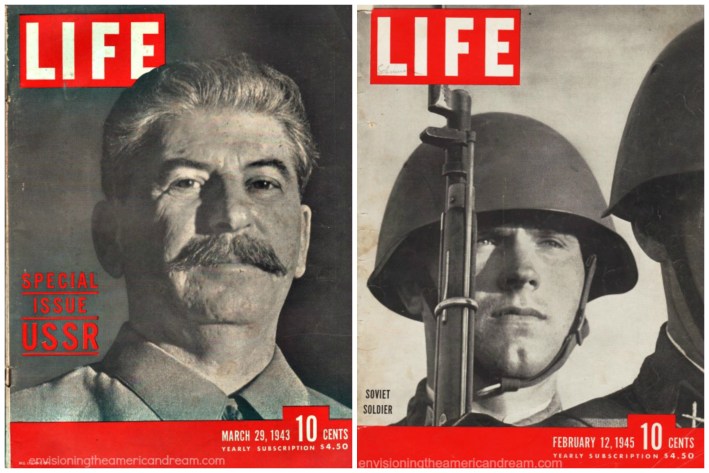
WWII Soviet Allies (L) Life Magazine cover 3/29/43 featuring warm and fuzzy Joseph “Uncle Joe” Stalin (R) Life magazine cover 2/12/45 featuring our brave ally a Soviet Soldier courageously driving on to Berlin
The big chill almost made us forget that only a few years earlier, this big brutal Russian bear had been our warm and fuzzy teddy bear of a wartime ally
During WWII, no one could hold a candle to those brave Stalingrad sacrificing red white and blue Russians. Led by twinkly-eyed pipe-smoking “Uncle Joe Stalin they were our comrades in fighting the Nazis.
Songwriters cheered and praised our Soviet comrades as we whistled “You Can’t Brush Off a Russian” and “Stalin Wasn’t Stall’in.” Selling the Soviets to us like a bottle of Pepsi, one ditty went:
“The Soviet Union hits the spot
12 million soldiers, that’s a lot
Timashen and Stalin too
The Soviet Union is Red white and blue.”
The Big Chill

As the war came to a close the Soviets and Americans converged in Berlin, toasting each other at their shared victory.
The guns fell silent in Europe in May 1945 but the post-WWII world would have very little peace. A hot war might have ended with those 2 fiery Atomic Blasts in Japan, but another war, a cold on,e began with our former allies in arms, the Russians.
By 1946, the world was changing at a dizzying pace.
Maps had been redrawn, swelling and shrinking the areas of countries, creating new boundaries, as cards were re-shuffled and friendships dissolved. Like so many war-born marriages, it turned out our grand alliance with the Soviets was more a marriage of convenience. Uncle Joe, our warm and fuzzy teddy bear, quickly turned into a cold-blooded grizzly bear ready to gobble up crippled Europe, turning its starvin,g shivering population into godless Communists. As Soviet tanks angrily roamed Eastern European streets, Churchill warned of an Iron Curtain descending over Europe.
Our war-born goodwill faded as quickly as Elizabeth Arden’s vanishing cream.
Better Dead Than Red
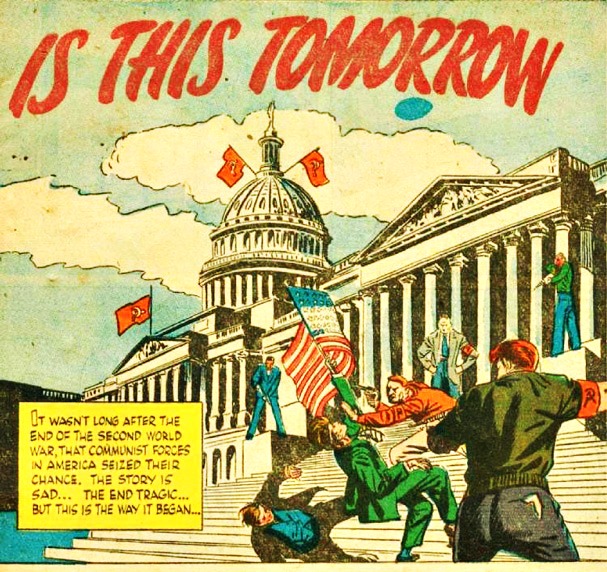
Convinced the Russians had embarked on an aggressive campaign to destroy our government, establishing the American Way of Life as ideal became even more crucial during this time contrasting it to the “Ruthless, Godless Communist” way of repression. We were to be on alert to the menace of Communism.
As the Cold War was heating up, a series of events in the late 1940s pointed to the fact that the security of Western Europe was tied to the security of the U.S. The threat of Soviet invasion of Western Europe, pushing further into the freedom-loving democracies, hung over the continent.
As if shifting gears between enemy and ally was as effortless as the automatic transmission in your Chevrole,t the considerable fury and fear that had fueled our hatred of those bloodless Nazis had been and swiftly rerouted to those Godless Russian commies.
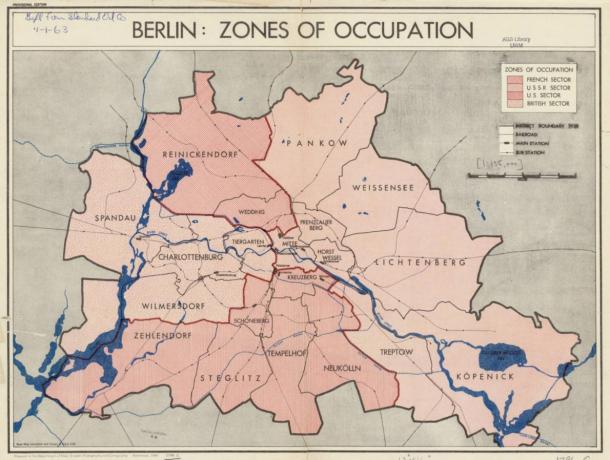
Germany, in fact, was a constant cause of concern.
After the war, Germany had been carved up into 4 occupied zones between the Allied victors of WWII. Berlin itself was divided into Communist East Berlin and democratic West Berlin. But Berlin was stuck deep inside the Soviet-occupied parts of East Germany. West Berlin was a thriving, cosmopolitan city. In Soviet East Berlin the destruction of the war was still visible, the people far from prosperous, with luxury items scarce. Every year tens of thousands of East Berliners fled to capitalist West Germany.
The fear was that the Soviets wanted Germany to be the communist centerpiece of Europe. With Germany a Soviet satellite, Stalin licked his chops with the thought of Western Europe falling under the domination of the USSR. In June 1948, the Soviets imposed a blockade of Berlin in hopes of starving the Western Allies out of Berlin.
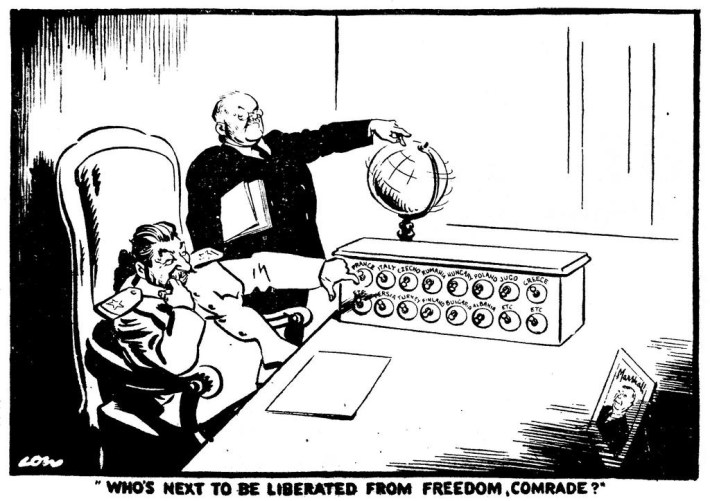
The same year the Soviets launched a coup in Czechoslovakia, overthrowing a democratic government. They had already placed a communist government in power in Poland and extended its sway to every Eastern European country it occupied since 1945.
Atomic Blast
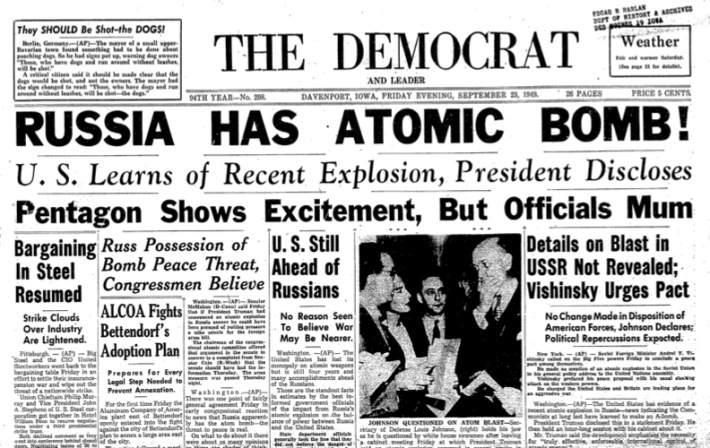
Adding fuel to the fire, America’s nuclear monopoly came to an abrupt end in 1949.
We were just digesting the Communist takeover of China when, on a hot summer morning in August, the Soviets detonated an atomic bomb, sending a shock wave around the world. Many feared an impending war with Russia. As long as the aggression existed in the form of the Evil Empire and “their unrelenting drive to enslave humanity,” the threat of an unwanted nuclear war would cast a long shadow.
The clear Soviet provocations created the urgency for the collective defense of Western Europe.
This was the grave backdrop as talks proceeded on the North Atlantic Treaty.
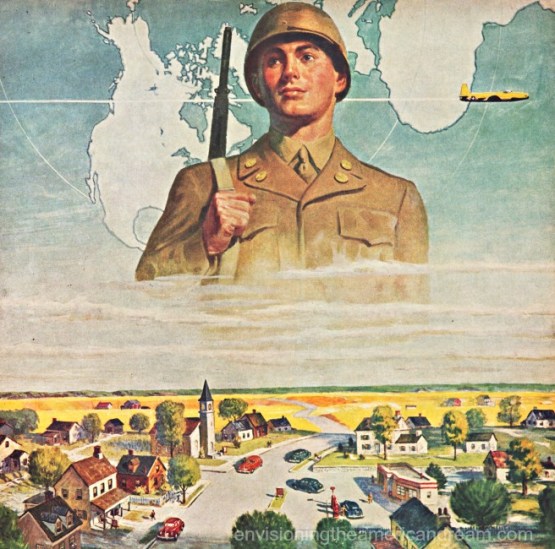
Europe was still clawing its way out of the destruction of the war, and to be credible, any collective defense had to include the U.S. and Canada. After the war, much of the world was economically shattered, returning home to cities that were often just rubble of broken bricks and smoldering wood, the desolate shell of a former city not yet done burning.
In our country, our economy was booming, and there wasn’t a single building demolished by bombs, a brick displaced, or a window broken and the only geographical scar was the one we ourselves had made on the empty deserts of New Mexico.
America had come out of the war as the only major industrial power not severely damaged, the richest country on earth.
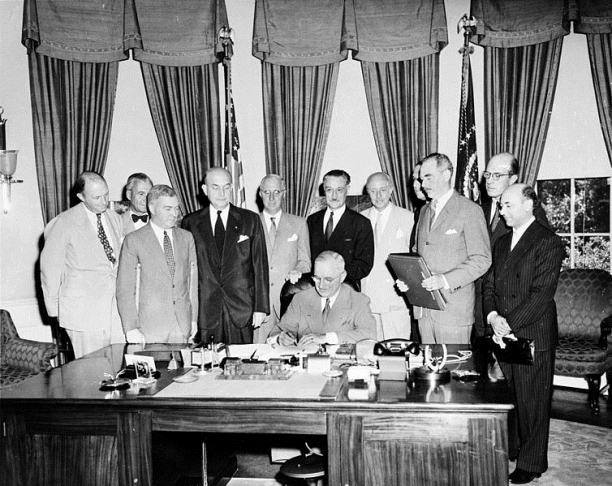
President Harry Truman signing the North Atlantic Treaty, which marked the beginning of NATO in a special signing ceremony on Aug. 24, 1949
European leaders met with U.S. defense, military, and diplomats at the Pentagon, exploring a framework for a new and unprecedented alliance.
All members agreed to defend one another – that is still the core of the alliance. It was a security pact stating that a military attack against one would be considered an attack against them all. NATO was both a military alliance and also ideological. These were all liberal democracies, and the will to push back against totalitarianism and Communism ran deep.
The North Atlantic Treaty, signed by twelve nations on a Monday afternoon in April of 1949 in Washington, D.C., saw the United States accept the lead in the free world’s postwar resistance to Communist aggression and subversion.
We accepted our banner as leaders of the Free World with pride and purpose and commitment
Today
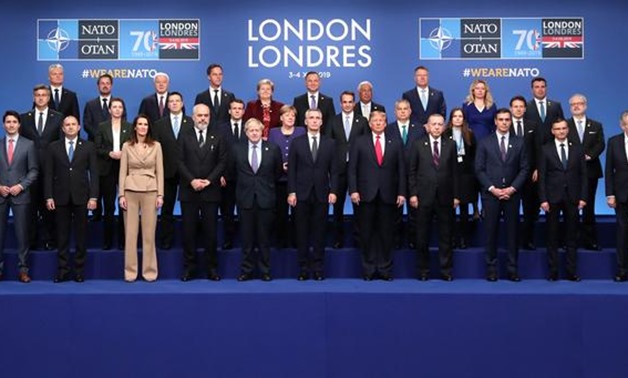
NATO is the strongest, most successful alliance in history
But it has never been just a purely military alliance. There is a special emotional bond between America and the European allies. It is a political alliance as well, based on the common aspirations of its members for freedom and peace. As the NATO treaty states, its members are determined to safeguard individual freedom and the rule of law. These values are far from obsolete
But these principles are under assault today. They come from those who oppose the international order. They try to undermine or even change the rules that have governed the age of democracy and prosperity since World War II.
Today, we are the lawless tyrants we fought against.
What Donald Trump has done in the name of the American people is unthinkable.
NATO may well be done if Trump invades Greenland, the Danish PM warns.
Trump’s sphere of influence doctrine claims to give him the right to dominate any sovereign state he wants within his sphere, which includes North America and Latin America
The democracies of NATO need to stand together to overcome these challenges.
Copyright (©) 2026 Sally Edelstein All Rights Reserved



 Envisioning The American Dream