


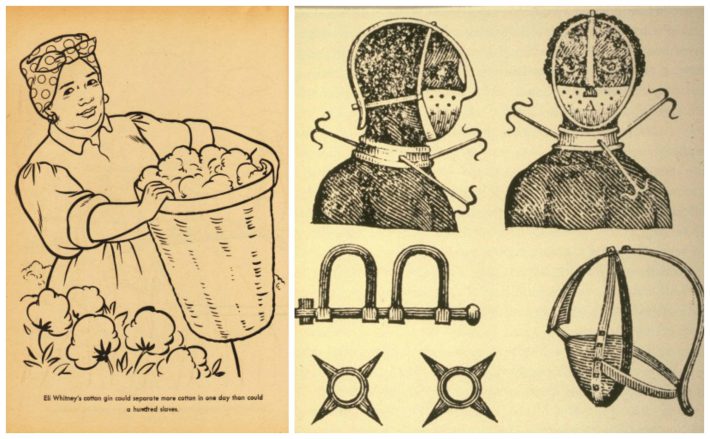
The Tortured Truth about Slavery. Slavery was routinely sanitized for children, including in my own childhood. As much as we whitewashed over the brutality of slavery as evidenced by this (L) happy slave as portrayed in a 1958 children’s coloring book, slaves were regularly beaten and often tortured (R) as seen in this illustration of instruments of torture used on slaves.
Who knew being a slave in the antebellum South benefited African Americans by teaching them important life skills?
Nobody.
Talk about torturing the truth.
In his anti-woke campaign, De Santis is torching history and truth in Florida with the speed and destruction that Sherman rampaged Atlanta.
Banning books is not enough. Now it’s banning reality.
As part of the new curriculum Florida’s middle school students must learn “how slaves developed skills which in some instances could be applied for their personal benefit.” Useful skills like how best to try to avoid being raped, beaten, whipped, or killed,
The only learned skills that were beneficial were survival skills just as the only ones who benefited from slavery were the slave owners who lined their pockets.
They defended the legal enslavement of people for their labor as a benevolent, paternalistic institution with social and economic benefits.
Slavery as a positive good was the prevailing view of Southern politicians before the Civil War.
This is not the view we expect in the post-civil rights era.
Whitewashing the Truth
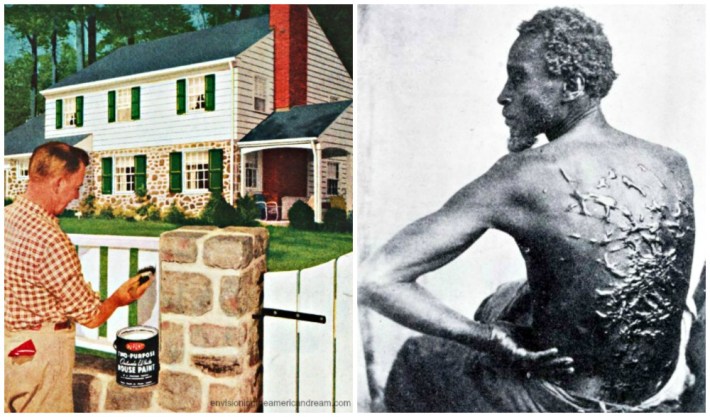
America’s sense of moral superiority has always been blemished by that “peculiar institution” slavery- the stubborn stain we just can’t whitewash away.
But not for lack of trying.
Over the years Americans have told themselves varying stories about enslavement of blacks presenting slavery as perhaps wrong but not such a bad thing.
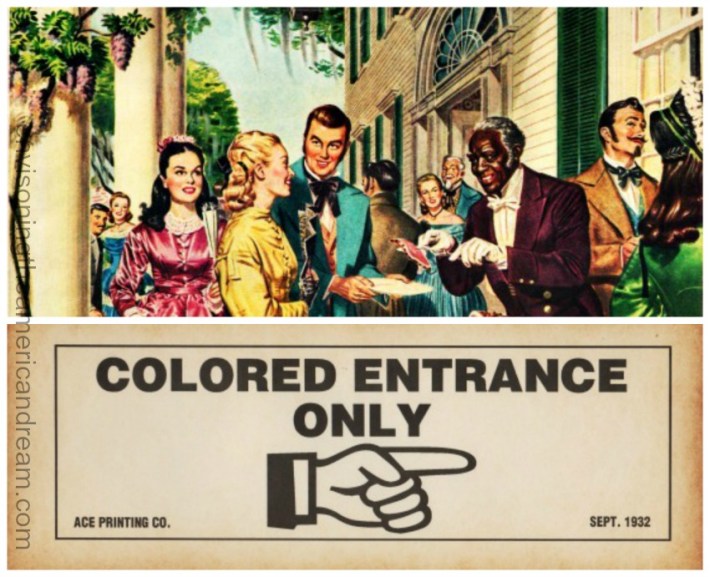
The mythology of the grand Old South is seductive. The Civil War was fought and the Confederate flag was hoisted to preserve the “traditional” Southern way of life as immortalized in countless movies and books. Even today Gone With the Wind, despite its many inaccuracies, forms the basis of American popular memory of the glory of the Old South.
Viewed through a gauzy haze of magnolia blossoms and weeping willows, the heritage of happy antebellum plantation life and their equally happy, loyal slaves co-existing in a mutually beneficial arrangement, is of course pure fiction. The romantic South is a figment of American popular imagination but one that has deep roots in our culture
In a 1937 textbook called “Our Nations Development” slavery was as painfully whitewashed as you could get: “Nor was the slave always unhappy in his cabin. On the contrary, he sang at his work …if his cabin was small there were shade trees about and a vegetable garden nearby.”
Echoing today’s policing of textbooks, The United Daughters of the Confederacy were the chief propagandists of “The Lost Cause.”
By the early 20th century, the Lost Cause was the official history in Confederate states and in most northern textbooks too. The Daughters of the Confederacy policed public school textbooks to ensure a history of the confederacy that was “just” censuring lessons that might be too admiring of Lincoln and too disparagingly of Jefferson Davis or which suggested white southerners had been cruel slave masters determined to preserve slavery.
Today in Florida, truth itself seems like a lost cause.



 Envisioning The American Dream
Sally, we are of a like mind. Here is a post from a couple of days ago. Keith
LikeLike
Very much on the same waver length. Thanks for sharing your post.
LikeLike