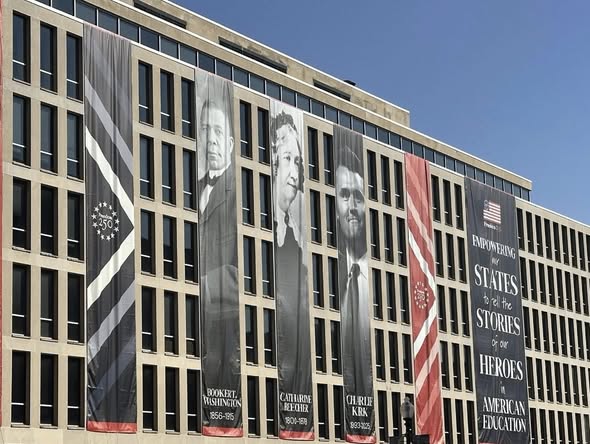
With each new banner unfurling on buildings in Washington D.C. there are lessons to be learned.
The latest display at the Department of Education makes clear the Trump curriculum.
A few weeks ago, a large blue banner featuring a photo of a glaring Donald Trump and the words “Make America Safe Again” was unfurled at the Justice Departments headquarters in DC. The message was clear – this was a striking symbol of the president’s control over our top law enforcement agency, eroding the department’s tradition of independence from White House control.
Who Belongs on the Banner?
Now suspended in heavy-duty vinyl above Washington’s sidewalks, a carefully curated cast of historical and contemporary figures instructs passersby on what American education will look like.
Most notably, the Trump regime has hung a banner honoring Charlie Kirk on the Department of Education building for America’s upcoming 250th Anniversary. The banner reads “Empowering our states to tell the stories of our heroes in American Education.”
Heroes? To who?
Choosing an ideologically loaded figure like conservative activist Charlie Kirk signals a shift towards a particular politicized vision of education.
With his controversial history of racist and misogynist rhetoric, the appearance of the martyred far-right commentator has understandably caused the most uproar.
But it is the subtle message of his companions, Catharine Beecher and Booker T. Washington, that is worth looking at.
What stories do these choices tell?
It’s the stories they want us to hear.
Catharine Beecher
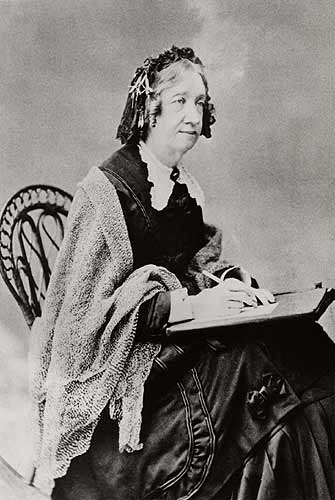
Echoing today’s “trad wife,” Catharine Beecher believed that political involvement would undermine women’s moral influence, promoting the concept of separate spheres where women’s power was centered in the home and school.
At first glance, Catharine Beecher seems an obvious choice in the field of education. A prominent 19th-century educator and author who championed women’s education and their roles as teachers.
An admirable role model for girls.
But she was also a staunch opponent of women’s suffrage. Despite her work for women’s educational advancement, Beecher opposed granting women the vote, believing it would be “an act of oppression” that forced them into the male political sphere.
While Beecher never married, she promoted the idea that women should focus on nurturing children and supporting the family, much like today’s online “trad wives” influencers advocating for homemaking as a high-status, fulfilling career.
She elevated homemaking, arguing that women’s influence within the home was more crucial than political participation.
A strong believer in distinct gender roles, Beecher described the home as “woman’s “manifest destiny,” calling it “the greatest work that was ever committed to human responsibility.”
Catharine Beecher was the older sister of Harriet Beecher Stowe, the famous author of Uncle Tom’s Cabin, which leads us to Booker T. Washington.
Booker T. Washington
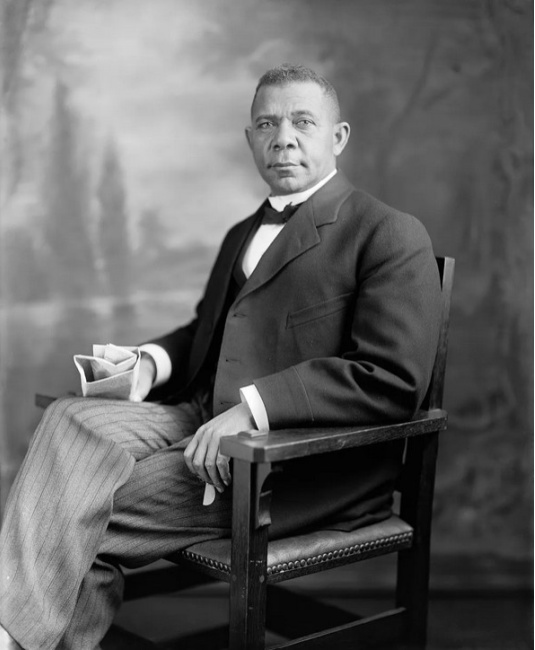
Most school children learned about Booker T. Washington in their grade school history books. Along with Washington Carver, he was one of two Negroes we read about in our mid-century primers.
But we never learned that he was thought of as an Uncle Tom.
Famous for founding the influential Tuskegee University, Washington is a perfect choice for an educational role model.
He’s perfect, too, in the Trump regime because he was also a conservative. His controversial accommodationist approach to race relations included advising African Americans to accept social segregation and disenfranchisement in exchange for economic, vocational, and educational opportunities.
During Jim Crow, he argued for building goodwill with southern whites working within segregation. Arguing that blacks should focus on economic progress rather than fighting segregation, he opposed protests, believing agitation for political rights foolish.
Washington’s public refusal to directly challenge segregation drew intense criticism from other black leaders. Often labeled an Uncle Tom by critics, particularly W.E.B. Du Bois, they felt his approach was too submissive to the white community, encouraged white supremacy, and hindered the fight for civil rights.
His position of accommodation to segregation came into conflict with increasing calls for African Americans and liberal whites for more aggressive action to end discrimination
Washington’s “accommodation” strategy is considered the cornerstone of modern Black conservatism, emphasizing economic empowerment and social stability over political turbulence. Today’s conservatives like Justice Clarence Thomas echo this by arguing economic independence is the best path to true equality for Blacks, often viewing government-led social programs and “agitation” as counterproductive.
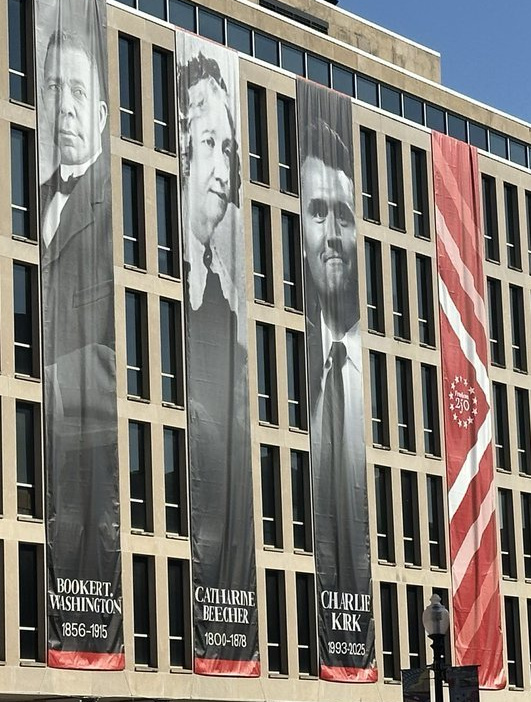
The decision to adorn the Department of Education Building with banners highlighting figures like Charlie Kirk, Catherine Beecher, and Booker T. Washington isn’t just ornamental.
Their choice was not arbitrary or neutral.
It symbolically reflects the gradual transformation that Project 2025 wants to promote to overhaul curriculum narratives in favor of a selective, conservative vision of American history and values.
The official rational frames these figures as having “shaped the future of education.”
It more subtly shapes the future direction of the Trump administration.