


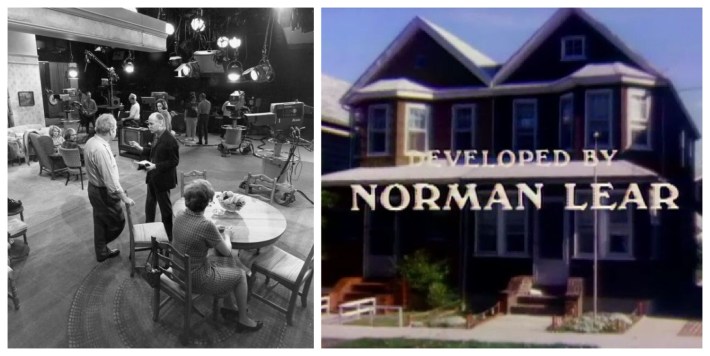
Where were you on the night of January 12, 1971? Specifically at 9:30 pm EST.
You may be scratching your head at what seems like an obscure date, but if you are a certain age, that chilly Tuesday night changed TV forever.
That was the night Norman Lear’s brainchild, All in the Family premiered and the American TV landscape was forever altered. For the first time, Americans heard the words “hebe, coon, and spic” said on national TV, by a red, white, and blue bigoted man from Queens.
And that was just the first night.
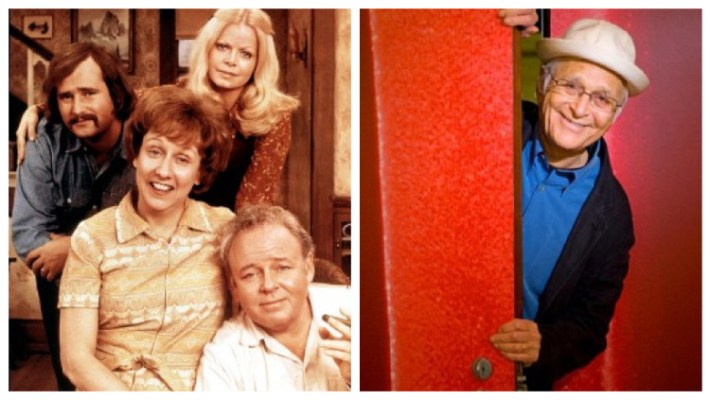
Like the word “artisanal” groundbreaking is an overused word diluted by its excessive use, but there is no other word for the shows that the great, late Norma Lear created. L) Cast of All in The Family (R)Norman Lear
As a 15-year-old, this groundbreaking show would be all anyone ever talked about the following day at High School. Accustomed to bland TV fare like My Three Sons, Green Acres, and Petticoat Junction, this show had teeth.
There had been so much anticipation for this controversial program that no one knew what to expect. The switchboard operators for CBS were on high alert waiting for the switchboard to light up like panic time at Mission Control.
All in a Tuesday Night

TV Guide “All in The Family” May 29-June 4,1971
That Tuesday night, my parents, older brother, and I settled in the living room to watch the new show on our recently purchased RCA color TV. At last, we had broken the black-and-white barrier and could watch the world in living color. We rarely watched television shows together as a family. Normally, after dinner we each spun off in our own orbit to watch our program of choice, each in their own room with their own portable TV set gratis of Edelstein Pawnbrokers. But like watching the Beatles on Ed Sullivan this was a TV event.

CBS Logo
At 9:30 we turned the dial to CBS just as the end of Hee Haw. This cornball show from fictional Kornfield Kounty never got any air time in our Jewish Long Island house. After the fadeout to the show, the station identified itself with its trademark eye and went to commercial.
Then a disembodied voice launched into an unexpected kind of pitch as a disclaimer:
“The program you are about to see is All in The Family. It seeks to throw a humorous spotlight on our frailties, prejudices and concerns. By making them a source of laughter we hope to show – in a mature fashion- just how absurd they are.”
The warning had the feel of the recent surgeon general warning that appeared on the side of cigarette packs – the following show could be hazardous to the emotional health of the sensitive viewer.
The look on my parent’s face said it all. What in the world were we getting into.
Those Were the Days
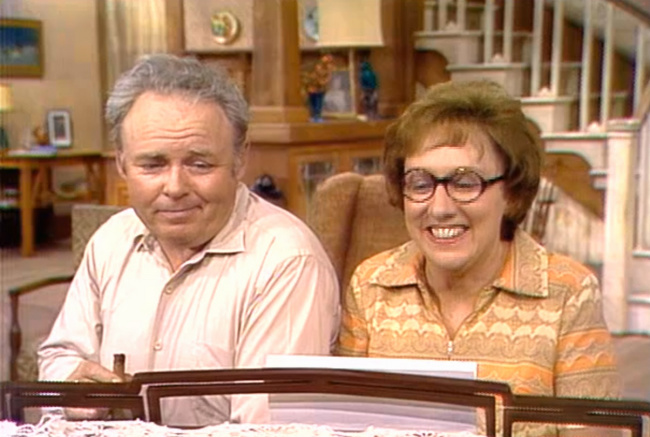
Opening “All in The Family” Carroll O’Connor and Jean Stapleton
What came on next was the pilot of All in The Family.
Things were said for laughs that had never been heard before on an American television comedy. Said mostly by Archie Bunker a flag-waving, John Wayne-loving, loveable, blue-collar bigot, bemoaning a fading America
Long before Donald Trump, no one represented the silent majority of fading white male patriarchy than Archie Bunker that other sexist, racist, xenophobic from Queens, N.Y.
Bellowing, snorting, and mocking, Archie tilted nonstop at his own self-proclaimed enemies – anybody who wasn’t a white Anglo-Saxon and Protestant.
“Feinberg, Feinstein- it all comes to the same thing, and I know that tribe.”
Or “Let the spades and spics go out and hustle, just like I done.”

The cast of All in The Family: Rob Reiner, as son-in-law Mike, Gloria’s Sally Struthers, Carroll O’Connor as Archie Bunker, and Edith played by Jean Stapleton
The verbal gunplay didn’t end there.
His liberal son-in-law Mike and favorite target was called a “dumb polack” and like her “meathead husband” he referred to his daughter Gloria as a “weepin’ Nellie pinko.”
His somewhat daffy wife Edith wasn’t considered worthy of serious discussions and was consistently told to “Stifel yourself.”
Her remarks were innocent but no less shocking in their innocence. When Archie made reference to “black beauties” Edith reflected and with a bit of pride, said, “Well, it’s nicer than when he called them coons.”
And this was all in the very first 30 minutes.
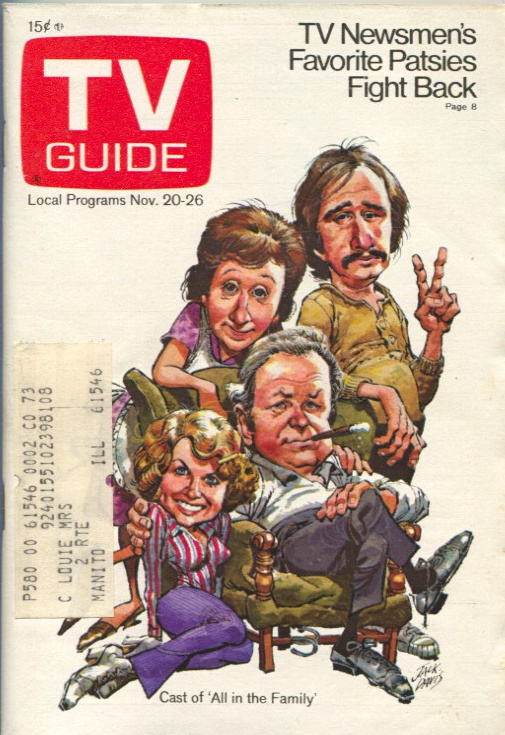
TV Guide Cover November 20-26 1971 illustration Jack Davis
When the show was over, there were no tidal waves of righteous indignation as expected and it didn’t score well on the Neilson scale at the initial airing. But it gathered steam and ratings went up. The show moved to a permanent Saturday night time slot where it led an unstoppable lineup including MASH, Mary Tyler Moore Show, Bob Newhart, and Carol Burnett.
Silent Majority
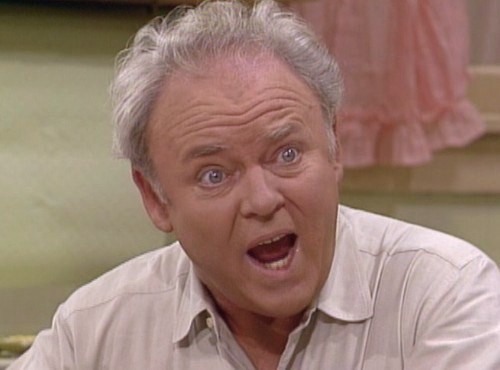
Archie Bunker
Archie Bunker, became a powerful spokesman for those President Richard Nixon had termed the “Silent Majority.”
Resentful, Archie was fed up with intellectuals, women libbers, bleeding heart liberals, outsourced jobs, and other elites intent on messing up a way of life that was working pretty well.
This blue-collar worker from Queens grappled with the big issues of the day- affirmative action, gay pride, women’s rights, the sexual revolution, and his railing at elites has become the leitmotif of American politics ever since.
“I’m white, I’m male, I’m protestant,” Archie Bunker once declared. “Where’s there a law to protect me?”
Girls Were Girls and Men Were Men
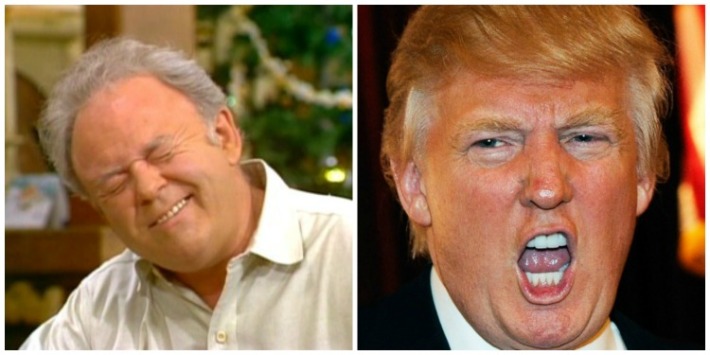
Two Queens, N.Y. native sons
Suddenly white male entitlement was being challenged, beginning its slow decline.
Like MAGA supporters today, Archie missed it and wanted it back. Just as Archie Bunker pined for the good ol’ days, Trump has fetishized the Good Old Days not just in rhetoric or sentiment but in policy that aims to take us back to them.
All in the Family was satire.
Donald Trump is no joke.
Norman Lear a champion of social justice was a genius.



 Envisioning The American Dream
Viewers of All in the Family felt the connection to ordinary people “just like us.” And Lear cared cared. ordinary families. When asked when Trump came on the national stage what he thought of him, Lear said, “Trump is giving the middle finger to America.” He had a gift that changed our culture. My hero.
LikeLike
My hero too. He used his humor to address social issues and held a mirror to our foibles. His commitment to social justice was admirable.
LikeLike