


All that hot pink power still wasn’t enough to get Greta Gerwig a nomination for best director of the Barbie.
The blockbuster movie that challenged patriarchal norms asked us to think pink and the audience complied. My social media feed this summer was glutted with pictures of women empowered in their bubble gum pink tank tops and peachy pink dresses. Whether in high heels or cowboy boots, women’s feet were decked out in hot pink, magenta, and powder pink.
I hadn’t seen that much pink girl power since the women’s march in 2017 with their sea of pink pussy hats.
This felt like a real MeToo moment.
It was empowering as much as the message of the movie.
After years of being relegated to all things dainty, pink pulsated with power.
But just as American women had their reproductive rights snatched right out from under their pink pussy hats, the Academy Awards snubbed the director of the biggest box office movie that was itself nominated.
Pink suddenly seemed very girly again.
Tickled Pink

Pink for girls and blue for boys always seemed the natural order of things.
Naturally, my mother was tickled pink when I was born in 1955. Having given birth to the blues with my very difficult older brother Andy, she was ready to go all out girly and think pink.

When I arrived home to our garden apartment in Far Rockaway after my 10 day stay at the hospital after I was born, I was wrapped snug in a pink cotton receiving blanket. Encircling my tiny rosey wrist was a powder-pink baby bracelet with my name spelled out in little pink wooden cubes.
At six months old I moved into my brand-new suburban bedroom that was awash in hues of pink thanks to my mother and Tootsie my grandmother Sadies’s fancy New York City interior decorator.

There was new wall-to-wall pink plush Shagg carpet for me to crawl on whenever that milestone occurred. The walls were covered in pale powder pink wallpaper with darling pink lambs and kittens gambling through it, the same sweet lambs who decorated my peony-pink crib.
My wooden baby lamp had a carnation pink pleated lamp shade that cast a pinkish hue through the room. Sheer, pink organza curtains elegantly draping the windows looked lovely but did little to keep out the bright morning sun. Filled with cheer, there was no doubting this was a girl’s bedroom.
You’re A Girl Aren’t’ You?

Naturally, my first frilly party dress would be in a perfect shade of pink as would my matching taffeta petticoat and fancy panties trimmed in lace and ribbons.
A childhood defined by extreme shyness would elicit the same lovely hue of pink blossoming across my face whenever I blushed.

Vintage Advertisement 1967 Lustre Creme Shampoo
Entering my pre teens, I could wash my hair with Pink Lustre crème the pink shampoo made just for girls ( because its too delicate for anyone but a girl!)

“And only Lustre Crème is pink. Because it’s made just for girls. See, it’s a little too delicate for anyone but a girl. Pink creamy Lustre Crème. It’s the one shampoo made just for girls Because pink is just for girls . You’re a girl, aren’t you? Vintage ad 1967
In this all-pink universe, there would be no gender confusion.
Except we girls didn’t always think Pink
Manly Men Think Pink!

Young Boy With a Whip ( American School) Artist Anonymous ca 1840
The truth is pink was once the color for boys. Blue was considered the “feminine color” and pink for males
Before the 20th century, babies of both sexes were generally dressed in white gowns and were unisex in color .

Gainsborough, Thomas; The Pink Boy; National Trust, Waddesdon Manor

Then the marketing men stepped in.
By the late 1890s and the early 20th century, manufacturers attempted to sell more children’s and infants’ clothes by color-coding them. There was not a consensus yet so some manufacturers branded pink for boys and blue for girls, and vice versa.
It was common for mothers to be told that boys should be dressed in a masculine color like pink for them to grow into more manly men and girls should be dressed in a more feminine alternative like blue. Pink, was considered a kind of boyish version of the masculine red, and was considered too harsh for girls. Girls were therefore assigned the color associated with sky and daylight.

Portrait of a Boy in a Pink Sailor Suit By Jacques Emile Blanche
By 1918 things solidified.
An article titled “Pink or Blue,” published in the trade journal Earnshaw’s Infants’ Department in June 1918, settled the issue stating:
“The generally accepted rule is pink for the boys, and blue for the girls. The reason is that pink, being a more decided and stronger color, is more suitable for the boy, while blue, which is more delicate and dainty, is prettier for the girl.”
That same June, Ladies’ Home Journal agreed and published an article claiming that “the generally accepted rule is pink for the boys, and blue for the girls.”
The fact that the media had begun promoting the notion of one color or another being associated with one gender or another was likely the brainchild of marketing strategists. Essentially, clothing manufacturers and retailers had realized that they could double the amount of clothing sold.
By 1927, department stores had jumped on board with the trend of color coding and Time magazine printed a chart showing sex-appropriate colors for girls and boys according to leading U.S. stores.
Puzzled By Pink
But there were a lot of regional differences reported between how stores characterized the color. Stores like Best & Co. in Manhattan and Marshall Field in Chicago branded pink as a boy’s color. Others like Macy’s in Manhattan and Wanamaker’s in Philadelphia identified pink as a girl’s color.

It wasn’t until the late 1940s that manufacturers went in the opposite direction, as a result of Americans’ preferences as interpreted by manufacturers and retailers, and decided once and for all that pink was for girls, and blue was for boys.
The baby boomers were the first to be dressed in the sex-specific clothing that Americans are familiar with today.

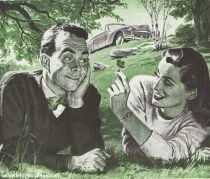


 Envisioning The American Dream
Fascinating story. Great illustrations!
LikeLiked by 1 person
I’m glad you enjoyed it.
LikeLike
I have a pink shirt. Never worry about whether it’s a “girl” or “boy” color. I just like it because it has a photo of my cat Andy as a kitten standing on my computer keyboard, staring out at me. Yeah, men can be cat people, too…wearing pink! <LOL!
LikeLiked by 1 person
Its funny because a pink shirt fro men is actually very preppie!
LikeLike
I had an Arrow button-down short-sleeved pink shirt in 1966 at the University of Nebraska. I guess that validates your comment! All that was missing was Brooks Brothers slacks, jacket, and tie.
LikeLiked by 1 person
You got the look down!
LikeLiked by 1 person
Excellent post! When I had to wear a shirt and tie for work I had several pink shirts. I also had a couple of pink ties to go with white shirts. It is interesting how the colors changed fairly recently. That’s good ol’ stereotyping for ease of marketing for ya…
LikeLiked by 1 person
You know who else used to wear a pink tie? Trump. If you watch eary shows of the Apprentice he regularly wore a wide silk pink tie.
LikeLike