


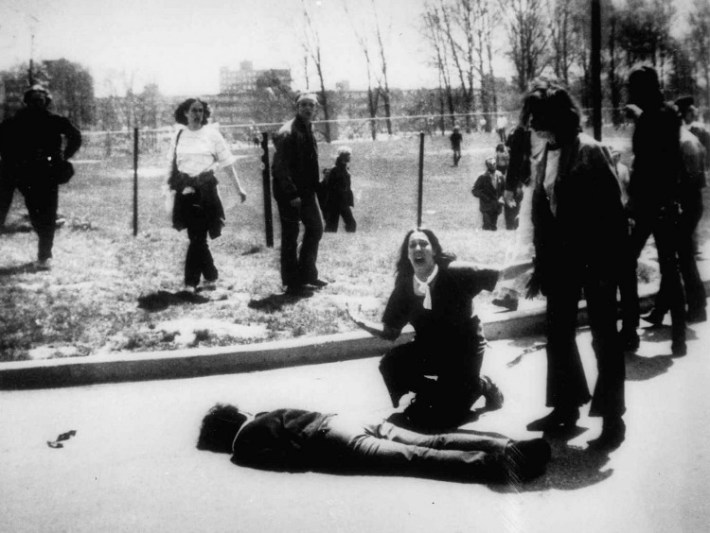
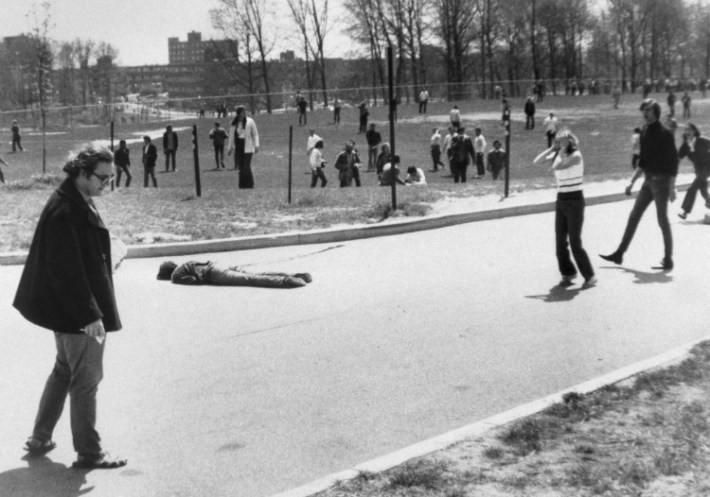
On May 4, 1970, the Ohio National Guard was sent to break up an anti-war protest at Kent State University. It ended in 4 dead wounding 9 others. (Photo by John Filo)
The sight of armed officers on our college campuses chills.
Republicans who are calling for the National Guard to be sent to colleges to intervene in pro-Palestinian protests have a dim memory of what can happen when troops are sent to campuses to clear out protestors.
But burned into my memory as a 15-year-old in 1970 is the tragedy of Kent State.
Seared forever into my consciousness, this haunting image of a tormented teenage girl screaming in horror as she crouched beside the fallen body of a Kent State student who had just been shot, would join those other iconic black-and-white photographs that defined my childhood.
A grimacing Lee Harvey Oswald grasping his belly after being shot live on TV by Jack Ruby.
A fatally wounded Robert Kennedy staring wide-eyed as he lay sprawled on the floor of a hotel kitchen, his head in a pool of blood from a gunshot.
The shots fired at Kent State left an already divisive country reeling.
In the spring of 1970, the country had been shaken to its core by the senseless shootings that took place at Kent State University when Ohio National Guardsmen leveled their loaded guns, aimed, and fired into the crowd of unarmed college students.
As a teenager trying to make sense of a senseless act, I could never have conceived of a time when a place of learning would not be considered a safe haven.

May 4th, 1970 began as an ordinary Monday in an extraordinary time.
The Vietnam War had polarized the nation. On college campuses across the country where anti-war sentiment ran high, protests were erupting in reaction to the recent bombings in Cambodia.
In late April the U.S. had secretly invaded Cambodia widening the Vietnam war. On Thursday night April 30th President Nixon announced to Americans in a televised address that we would expand our forces into Vietnam’s neighbor.
For those who already saw the war as inhumane, this was the last straw. Protests occurred the next day.
That Friday, Kent State, like other colleges, held an anti-war rally. Fiery speeches against the war and the Nixon administration were given, and a copy of the Constitution was buried to symbolize the murder of the Constitution because Congress had never declared war.
Another rally to be held on the commons a large, grassy area in the middle of campus was called for noon on Monday, May 4.
As a sophomore in a high school, my Monday, May 4th began as an ordinary Monday in an extraordinary time.
I had just finished my third-period social studies class at noon and was headed for the cafeteria. While I was mindlessly picking at my usual dieter’s lunch of Friendship cottage cheese and Jello, an anti-war protest in an Ohio college was turning violent and deadly.
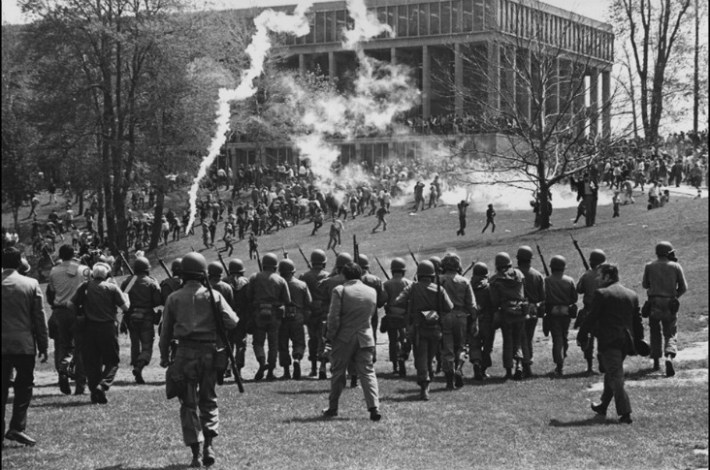
While my friends and I speculated on that night’s Laugh-In’s lineup, National Guardsmen opened fire from powerful M1 rifles on an assembled crowd of college students unleashing 67 live bullets in 13 seconds killing 4 and wounding 9 others.
In a world before social media and without 24/7 news, I would be oblivious to the tragic events at Kent State as frightened college students scrambled, running for their lives. For now, my sense of disbelief centered on the breakup of our class’s most popular couple.
“Four Dead in Ohio”
I would have to wait till evening to learn about the bloodshed at Kent State from Walter Cronkite, just as I had so many other tragedies.
“Some people here believe the Guard, under the pressure of a rock-throwing attack, fired its weapons indiscriminately, killing four people,” CBS News correspondent Ike Pappas reported from the scene.
The protests began after President Richard Nixon announced the invasion of Cambodia. Students rallied on campus over the next four days, at one point setting the ROTC building on fire and rioting in downtown Kent.
The Ohio National Guard was called in, and school officials banned a rally planned for May 4th due to the potential for more violence.
But the students still gathered as planned. After repeated warnings to disperse, tear gas canisters were fired into the crowd. Eventually, more than seventy troops advanced on the students. Tensions escalated, and twenty-eight guardsmen fired their weapons into the crowd of demonstrators.
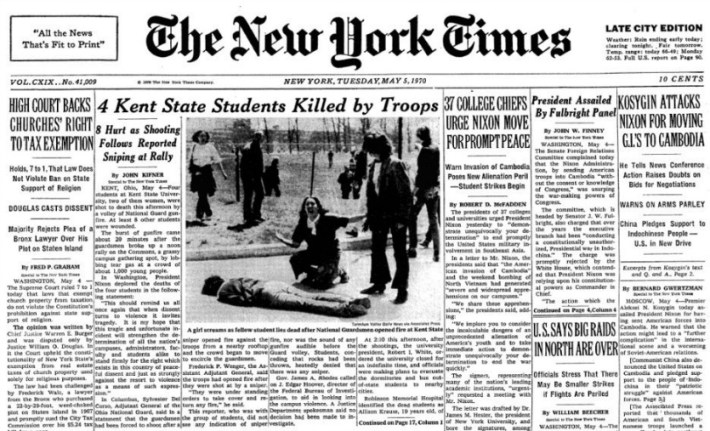
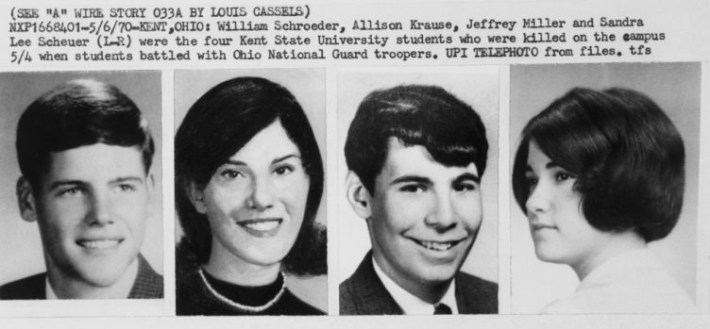
The next day the graphic image of an anguished screaming girl 14 year old Mary Ann Vecchio the 14-year-old kneeling girl with the neckerchief crouching beside the fallen Kent State student 20-year-old Jeffrey Miller who had just been shot, would appear on the front page of every newspaper.
This seminal photo by John Filo would forever define that event for me and countless other baby boomers.
Baptized at an early age by senseless bloodshed, violence, and guns would chase me my whole life.
But this tragic event felt different. Now it wasn’t just our leaders being shot. They were coming for ordinary Americans. We too were in danger and we couldn’t count on our government to protect us. They were the shooters now.
These fallen students, teenagers, were only a few years older than I was. If it could happen to them…
Now they were killing kids.
Kids like me.
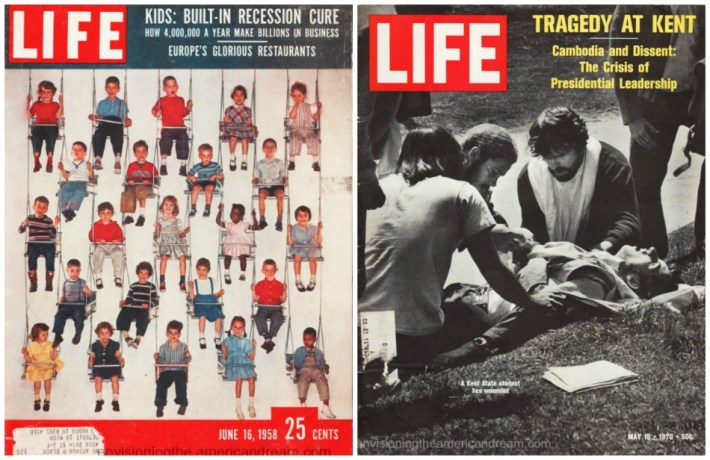
Kids who like me had grown up watching Captain Kangaroo, played with Barbies, read MAD Magazine, and dotted their faces with Clearasil. Kids who had been traumatized by the events in Dallas. And Memphis. And in Los Angeles.
These were kids whose fathers were like mine, ex-GIs who had fought in the Greatest War and were providing their children the post-war American Dream; whose mothers joined the PTA, baked Betty Crocker Cake from a boxed mix, and curled their hair with a Toni Home Permanent.
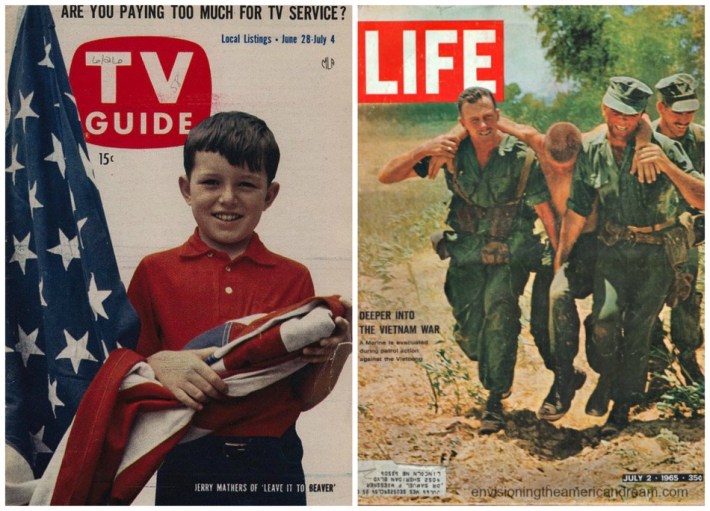
These kids grew up like me believing in American exceptionalism. It was an act of faith like reciting the pledge of allegiance with our hands over our hearts. Before being disillusioned by Vietnam we believed in the beaches of Normandy.
But the answers of 1945 dissolved so quickly into the nagging questions of 1965, when these same children began to come of age. They came to doubt their country.
The Great Society wasn’t so great after all. Vietnam was immoral.
These children of the suburbs who had once taken the American story to heart in movie theaters, and TV, now felt deeply betrayed by our government. It had always been a matter of faith and the loss of that faith was wrenching.
Betrayal by our country morphed into disbelief.
Now unbelievably, they were killing these kids.
In that moment at a little past high noon on an ordinary Monday in May, the unthinkable became real. Surely though this was an aberration, an extraordinary, isolated moment in history during a tumultuous time.
In 1970, my 15-year-old mind could never have imagined a time when school shootings would become part of our culture. As a teenager trying to make sense out of a senseless act, I could never have conceived of a time when a place of learning would not be considered a safe haven.
But now the exception has become the norm. The killing of schoolchildren has become commonplace.
We have long lost our faith.
And shots are still being fired.
Postscript
The spring of 1970 saw the first general student strike in the history of the U.S. Students from over 400 colleges and universities called off classes to protest the invasion of Cambodia,, the war in Vietnam, the Kent State shootings, and the killing of 2 black students at Jackson State College in Mississippi which occurred May 14-15. A group of student protestors were confronted by city and state police who opened fire killing 2 and injuring 12.
Only 10 days after Kent State it didn’t get the same attention.
Copyright (©) 2024 Sally Edelstein All Rights Reserved




Another well-told and timely history lesson. Thank you, Sally. I was a senior in the Spring and actively against the war. I joined students at nearby university and had to flee when busloads of National Guard advanced on the crowd. The next night, several of us went to see Costa-Gavras’ “Z,” which was totally chilling. Images of the last couple of days brings it all back. Darkly.
LikeLiked by 1 person
For those who came of age in the late 60s and early 70s these images we are witnessing are very hard to watch
LikeLike
As always powerful writing…
LikeLike
Thank you Pierre. It feels so timely.
LikeLike
The mitzva of removing Av tumah avoda zarah from within our hearts. Avoda zarah defined through the Book of Esther as assimilation and intermarriage with Goyim. Prior to Pesach the Torah commands the removal of all חמץ. The משל of חמץ teaches the נמשל of אב טומא עבודה זרה. Hence post Pesach the mitzva of counting the Omer likewise pronounces the שם מ”ב, Forty-two letter Divine Name with the k’vanna to remove avoda zarah from bnei brit hearts prior to accepting the revelation of the Torah on Sinai which the Chag of Shevuoth sanctifies as an eternal mitzva dedicated through the Divine Name of the bnai brit soul of האל.
According to the Yerushalmi Talmud over 247 prophets occupied in writing the Shemone Esrei tefillah. Herein serves as the basis of all Jewish kabbalah.
A huge black hole: all discussion on the Siddur which fails to address the simple fact that the Siddur together with the Book of בראשית addresses the Av/toldot relationship between time-oriented commandments to their toldot positive and negative commandments in the other four Books of the Written Torah.
Removal of the sciatic nerve, one of the few Commandments together with fruitful and multiply and circumcision in the Book of בראשית the Av Book to the toldot other 4 Books of the Torah! The tefillah on the Yom Tov and Shabbat “remembers”.
Remembers what? The oaths sworn by the Avot, the k’vanna of kre’a shma which links the 3 Divine Names in the opening p’suk of this tefillah דאורייתא to אלהי אברהם וכו in the adjacent Shemone Esrei דרבנן.
What oaths did the Avot swear when they cut a oath brit with HaShem? HaShem swore oaths to the Avot (future born seed plus the inheritance of the land to this future born [עולם הבא] chosen Cohen nation seed). What sworn oaths did the Avot swear in their brit alliance with HaShem? The Baali Tosafot teach אלהי אברהם as a reference to מלכות. This משל term מלכות interpreted to mean the dedication of tohor middot. Hence 13 middle blessing affixed to the revelation of the 13 tohor middot ‘ה’ ה’ אל רחום וחנון וכו.
Tefillah stands in the stead of korbanot. Korbanot NOT a barbeque unto Heaven. But an action of swearing a Torah oath (which requires שם ומלכות) “dedicated” as Holy to HaShem. As the 13 Middle Blessings stand distinct from one another a person should possess the wisdom which discerns the distinctions which separate the definition of one tohor midda from the other tohor middot the one from the others.
This ability/wisdom to discern like from like defines the concept of k’vanna — which all time oriented commandments require. This basis of Torah faith qualifies as the meaning to the term “Fear of Heaven”. All time oriented commandments stand upon this יסוד kabbalah of faith.
Removal of the sciatic nerve remembers the crisis, comparable to the Akadah of Yitzak, of Yaacov’s encounter with his brother Esau. Targum Uziel says that Esau approach Yaacov with an Army led by 400 Officers! In short Yaacov toast, just like the life of Yitzak at the Akedah!
Removal of the sciatic nerve: a tohor time-oriented commandment. The Book of בראשית opens with בראשית followed by נח. Tohor time-oriented commandments express Moshe Rabbeinu’s life & death, therefore choose life commandment. בראשית, contained in the first תמיד מעשה בראשית of the opening ברכה של קריא שמע. And נח, the death of all living, contained in the second תמיד מעשה בראשית at the closing of this opening blessing of kre’a shma.
Tohor time-oriented commandments emanate the power to Create the world or destroy the world יש מאין. Torah oaths created from nothing זה וזה. The B’hag ruled that rabbinic commandments 100 blessings, nir shabbat, nir hannukah, reading m’gilah esther, etc. as mitzvot from the Torah. All these rabbinic commandments, according to Rambam in his introduction to Sefer Ha’Mitzvot, tohor time-oriented commandments. The B’had in essence held that just as the תרי”ג commandments existed as toldot of tohor time-oriented Avot commandments as located in the Av Book of בראשית, all rabbinic halachot within the Talmud, if sanctified as time-oriented commandments qualify as commandments from the Torah itself!
Time-oriented commandments require כוונה. Understood as the dedication of tohor middot reveal to Moshe at Horev and explained by the kabbalah of rabbi Akiva’s פרדס understanding of the כוונה of the Oral Torah revelation at Horev — 40 days after the Sin of the Golden Calf avoda zarah which violates the 2nd Sinai commandments throughout the generations till today. How many times does the bible or koran bring the revelation of the שם השם? Doing mitzvot לשמה separates Jews in Israel from Jews in g’lut. The RambaN teaches in his Chumash commentary that doing mitzvot in g’lut only a “remembrance” to doing mitzvot לשמה in ארץ ישראל – the oath sworn lands for the chosen Cohen nation.
LikeLike