


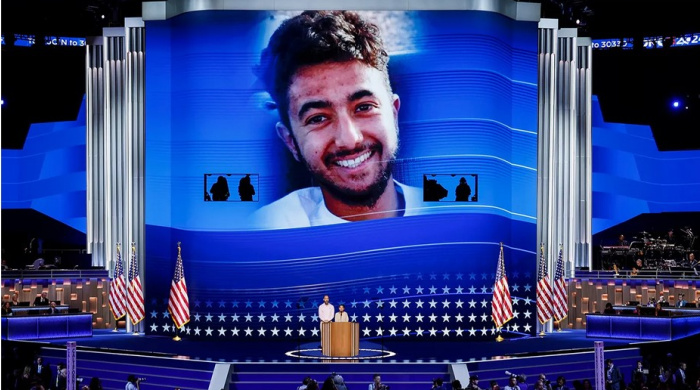
Hersh Goldberg-Polin is shown as his parents Jon Polin and Rachel Goldberg speak at the 2024 DNC.
You could hear a pin drop when an anguished Rachel Goldberg-Polin, bowing her head and touching her chest uttered these heart-filled words at the Democratic Convention in Chicago just a few weeks ago.
Hersh, if you can hear us, we love you. Stay strong, survive.
Those words were etched deeply in my mind. We can only pray somehow, impossibly the 23-year-old American Israeli who was kidnapped during the Oct 7 Hamas attack heard them and knew intuitively how much he was loved and missed.
His father then added, “Bring them home.”
A glimmer of hope still remained.

Remembering those words now is shattering as Hersh Goldberg-Polin is among the 6 hostages found dead in Gaza.
Held hostage for over 300 days, they were murdered. Executed,
Hersh became a face of the hostage crisis thanks to the advocacy of his parents when they addressed the convention in Chicago gaining the attention of 20 million TV viewers as they called for a ceasefire.
We are crushed for you. Our hearts break for you and all the families of those senselessly slaughtered.
May their memories be a blessing.





 Envisioning The American Dream
All so terribly sad.
LikeLiked by 1 person
And let’s pray that this horrible, horrible war ends soon.
LikeLiked by 2 people
It just can’t go on. The misery and horrors to humanity must end.
LikeLike
Sally, thank you for putting words to this tragedy, in the ongoing larger tragedy the Israelis are suffering every day. Look at these beautiful young people with their whole lives ahead of them, murdered after so much suffering. Wake up world and insist on the immediate return of the remaining hostages before it’s too late for all of them.
LikeLike
The unthinkable has happened and there must be an urgency to both release the remaining hostages and end this war immediately, or there will be no hostages to return.
LikeLiked by 1 person
So very very sad. This war just has to end.
LikeLike
There is now massive protesting in Israel right now.
LikeLike
There must be a ceasefire now that includes complete hostage release (no Stage 1, Stage 2 nonsense) and the immediate resumption of humanitarian aid to Palestinian non-combatants. But the world community cannot decide to look the other way, when Hamas decides to re-arm itself with a future October 7th massacre as its goal.
LikeLike
What diplomatic consequences of Israel breaking off all diplomatic relations with the United Nations and expelling the UN from all post 1967 lands and territories?
Profile photo for Moshe Kerr
Moshe Kerr
Breaking off all diplomatic relations with the UN would drastically reduce European powers to dominate the balance of power in the Middle East.
In the 1956 and post 1967 War, Britain and France attempted to treat Israel as a political pawn on the international chess board of Great Power domination of the Middle East states. Essential to grasp British and French strategic interests to seize the Suez canal in 1956. Had their plans succeeded Britain and France would have shared a domination in the balance of power in the Middle East as equals together with the US and USSR!!!
Now weigh upon the opposing scales French strategic interests which caused that loser of WWII to assume it possessed the authority to write the UN 242 revisionist history, which coined the political rhetoric propaganda of land for peace, occupied territories, and the absurd notion that territory – not acquired through war. This revisionist history negates the whole of French and British imperialism throughout the Ages.
Just and lasting peace … simple political rhetoric word salad propaganda. UN 242 attempts to force Israel to return to its 1948 Auschwitz-Birkenau borders. Just and lasting peace rhetoric word salad.
Shalom a verb, while peace a noun. Big difference. Shalom requires trust. No trust No Shalom. Just that simple. In 1967 Arab States with their famous Three NOS to Israel clearly Israel and Arab countries did not trust one another.
Therefore the peace in the Middle East propaganda rhetoric word salad … just propaganda and nothing more than propaganda which seeks to radically change the post 1967 balance of Power in the Middle East away from Israel as a great power in the region, back to being a political pawn. As prevailed in 1948, 1956, and before the June war in 1967.
Just and lasting peace rhetoric word salad: Shalom a verb, while peace a noun. Big difference. Shalom requires trust. No trust No Shalom. Just that simple. In 1967 Arab States with their famous Three NOS to Israel, clearly Israel and Arab countries did not trust one another.
Therefore the peace in the Middle East propaganda rhetoric word salad, just International great power propaganda. And nothing more than propaganda which seeks to radically change the post 1967 balance of Power in the Middle East away from Israel as a great power in the region back to it being a political pawn, as in 1948, 1956, and before the June war in 1967.
If Israel broke off all diplomatic relations with the UN all UN Resolutions 242,, 338, 446, 2334 etc would become null and void. Would Britain or France or both break off diplomatic relations with Israel?
Why? Because by Israel expelling the UN from the Middle East this would relegate France and Britain as minor pawns in the balance of power-sharing in the Middle East.
By expelling the UN, Israel could undermine the legitimacy of multiple UN resolutions that have sought to address the Israeli-Palestinian conflict, potentially leading to a vacuum in international law and norms. The absence of UN presence could exacerbate humanitarian issues in the region, as the UN plays a crucial role in delivering aid and monitoring human rights.
Egypt and Israel have a longstanding peace treaty (Camp David Accords of 1979), which has maintained a level of stability in their relationship. The expulsion of the UN could be seen as a provocative act, potentially heightening tensions in the region. Egypt might respond by reassessing its diplomatic stance, particularly if it feels that Israel is undermining regional stability. Egypt has strategic interests in maintaining a relationship with Israel, particularly regarding security cooperation and economic benefits. Breaking off relations could have significant repercussions for Egypt’s security and economic situation.
While Egypt might not immediately break off diplomatic relations with Israel, the expulsion of the UN could strain their relationship. The decision would ultimately depend on a complex interplay of domestic pressures, regional dynamics, and strategic interests. While Egypt might strongly condemn Israel’s actions, it is unlikely to break off diplomatic relations. The peace treaty with Israel is too important to Egypt’s security and regional interests, and the consequences of breaking off relations would be significant.
Britain and France have not taken such drastic measures, as have Jordan, Bahrain, Turkey, Bolivia, Colombia, Honduras, Chile, Belize, Brazil, South Africa and Chad have recalled their ambassadors to Israel or severed ties altogether in response to the conflict. Unlikely that either Britain or France will do likewise in the future.
Britain and France have diplomatic relations with Israel, and both countries have strong economic ties with the country. Annual bilateral trade between Israel and the UK exceeds £6.1 billion, and over 300 known Israeli companies are operating in Britain. France is Israel’s 11th-greatest supplier of goods and represents Israel’s ninth-largest market.
In April 2024, at least 130 British lawmakers wrote to Foreign Secretary David Cameron and Business Secretary Kemi Badenoch calling on the British government to halt arms sales to Israel. Pressure for an arms embargo has increased after an attack on a World Food Center convoy in Gaza, which killed seven aid workers, including three British nationals.
Britain’s readiness to impose a ban is partly linked to Israel’s refusal to allow the International Committee of the Red Cross to visit the Sde Teiman detention center, where Palestinian prisoners are held. The Red Cross has yet to visit stolen Israeli Oct 7th hostages in accordance with its mandate obligations. Britain’s readiness to impose a partial arms ban upon Israel, partly linked to Israel’s refusal to allow the International Committee of the Red Cross to visit the Sde Teiman detention center, where Palestinian prisoners are held.
Combining the possibility of Israel expelling the UN from the Middle East with the US terminating its NATO alliance in return for Russia withdrawing from Ukraine and Crimea presents a complex scenario with far-reaching consequences for global politics.
European countries would face heightened security concerns without the US security guarantee provided by NATO, potentially leading to increased defence spending and a more assertive foreign policy. The US America First withdrawal from NATO would weaken Western unity and could lead to a more fragmented international order.
The combination of these events could lead to increased regional instability in the Middle East and Eastern Europe, as power vacuums emerge and actors seek to exploit new opportunities. The global order could see the formation of new alliances, potentially shifting away from the traditional US-led system. While it could potentially lead to a resolution of the conflict in Ukraine, it also carries significant risks for global stability and security. The interplay of these events could have profound and long-lasting consequences for the international order.
The US withdrawal from NATO and Israel’s expulsion of the UN could create a vacuum in the region, potentially leading to a closer alliance between Iran and some Arab states. This could be driven by shared resentment towards the US and Israel, along with economic and political interests.
The US withdrawal from NATO could push the EU to seek closer ties with Russia, particularly in areas like trade and energy cooperation. This could be driven by the EU’s desire to maintain stability in its neighborhood and its dependence on Russian energy resources.
Eastern European countries, feeling vulnerable without US security guarantees, could form a new security bloc, potentially including Turkey and Israel. This could be driven by shared concerns about Russian expansionism and a desire to maintain their independence.
China, with its growing economic and political influence, could potentially mediate between Russia and the EU, forming a trilateral alliance. This could be driven by China’s desire to expand its global influence and its interest in securing its own economic interests.
The scenario presented could lead to a complex and dynamic realignment of alliances in the Middle East and Eastern Europe. The formation of new alliances would be driven by a combination of factors, including shared interests, strategic concerns, and the shifting balance of power. The outcome of this realignment would have significant implications for global security and stability.
Britain and France would likely struggle to maintain their traditional roles as power brokers in the Middle East. Their economic ties with Israel might not be enough to counterbalance the strategic shifts resulting from Israel’s actions. The US withdrawal from NATO could result in a fragmented approach to global security, with individual countries pursuing their interests, leading to potential conflicts and instability.
This scenario suggests a highly complex and volatile geopolitical landscape, where the expulsion of the UN by Israel and the US’s withdrawal from NATO could catalyze significant shifts in alliances and power dynamics. The interplay of these events would likely lead to increased instability, necessitating careful navigation by all involved parties to mitigate potential conflicts and foster new forms of cooperation.
If significant geopolitical shifts occur—such as a major power like the US withdrawing from its commitments or if member states begin to disregard UN resolutions en masse—this could erode the UN’s authority and operational capacity. The UN’s ability to effectively respond to global crises is crucial for its legitimacy. Continued failures to address major conflicts or humanitarian issues could lead to calls for reform or alternatives to the UN system.
By removing the UN, Israel would effectively remove the international framework that allowed Britain and France to exert influence in the region. This would reduce their ability to act as power brokers and leave them as minor players in the Middle East.
Before the Six-Day War in 1967, Israel was indeed in a vulnerable position. It was surrounded by hostile Arab states, and its security was precarious. The 1956 Suez Crisis, where Britain and France attempted to use Israel as a pawn, is a prime example of this vulnerability.
The 1967 war significantly shifted the balance of power in the Middle East. Israel emerged victorious, gaining control of the Sinai Peninsula, the West Bank, and the Golan Heights. This victory significantly strengthened Israel’s military position and regional influence. Therefore, the expulsion of the UN would likely strengthen Israel’s position, not weaken it. It would remove a significant source of international pressure and allow Israel to operate with greater autonomy.
LikeLiked by 1 person
More guilt trip “He died 4 you” Sanda Claus bull shit. Blood Libel slander, Goyim have no shame. UN-nations accuse Israel of “poisoning the wells”!
LikeLike