


Tupperware, the Queen of plastic containers has been dethroned marking an end to a post-war suburban success story
The famous “burp” heard round’ the world has been silenced.
Tupperware has filed for bankruptcy after 78 years.
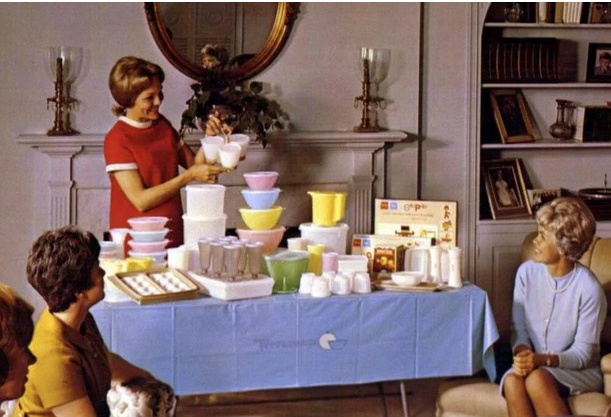
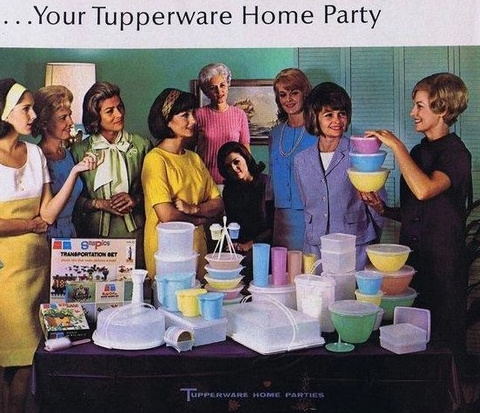
Few products are more symbolic of household life in post War War II America than Tupperware. As is the iconic Tupperware party where mid-century housewives gathered in suburban living rooms to be regaled by neighbors demonstrating the wonders of these plastic containers
The party is sadly over.
Sadly, it was a party I only heard about.
Tupperware What Dreams Are Made Of…For Some
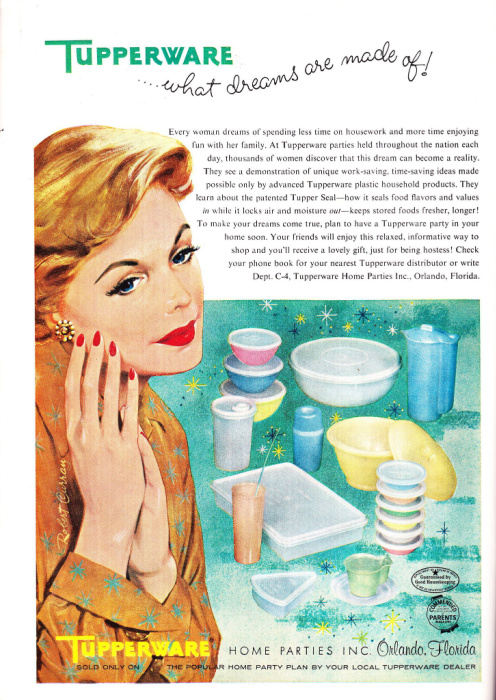
Vintage Tupperware Ad
The Smithsonian may boast over 100 pieces of Tupperware dating from the late 1940s in their collection but nary a one was ever part of the vast plastic storage collection of Betty Edelstein.
For a woman who lived out the quintessential post-war suburban dream, the perfect poster girl for the colorful Cold War world of carpools, cookouts, and cream of mushroom soup casseroles, Mom never once attended a Tupperware party.
Despite the new and improved, EZ-does-it mindset of mid-century living that infused my childhood home, a polyethylene Tupperware bowl storing remnants of yesterday’s dinner never took up space in my mother’s Frost Free Frigidaire.
Waste Not Want Not

But that is not to say we were not leftover devotees.
Perhaps as a carry-over from WWII shortages and rationing mentality, wasting food was not just a sin in my house, it was near criminal. There was never an insistence to be a member of the Clean Plate Club, because uneaten food would always be repurposed.
I come from a family of serious savers. Just as we held onto newspapers, magazines, letters, and all sorts of flotsam and jetson, leftover food was never thrown out in our house. No morsel was too small or insignificant to not save.
Truthfully, I cannot remember a dinner where some part was not kept for later.
Table scraps whether a few curled Del Monte canned green beans or a half-eaten veal chop would never be disposed of in the trash. Minute Rice may have taken moments to prepare, but in our fridge if there was a surplus, it could be saved for days.
Dubious Plastics

Vintage Pyrex Refrigerator storage containers
In the early 1960s while others were tucking their leftovers into raspberry-colored Tupperware containers Mom clung to her Pyrex refrigerator dishes, these sturdy containers with clear glass lids that came in bright primary colors and different shapes and sizes.
Mom was wary of plastics.
In 1946 when Earl Tupper first introduced his Tupperware Wonder bowl made from polyethylene waste material, plastics were unfamiliar in the home and not associated with food storage.
After the war, many didn’t trust plastic products convinced from their experience with cheap wartime materials that they’d break, chip, melt or smell.
At first, homemakers were wary of a material that they associated with bad smells, a weirdly oily texture, and cheap construction. Tupperware bowls’ most unique feature was also what held it back initially: the airtight lids wouldn’t seal unless they were “burped” beforehand, and that confused consumers, who returned them to stores claiming the lids didn’t fit.
Instead of being stacked in m’lady’s refrigerator, the containers sat in department store shelves.

Vintage Tupperware Ad
It would take an ambitious woman—and an army of amateur salespeople—to sell the innovative containers to America. The genius was how they were marketed -by a woman named Brownie Wise who launched the concept of the Tupperware party where products were peddled by housewives to their friends.
It helped make plastic acceptable.

A coveted Tupperware Party Invitation
Despite their popularity, my mother never attended a Tupperware party. Perhaps the Temple sisterhood gals were too busy with their rummage sales and Bingo night to hold one.
But her interest in plastic would change.
Once food manufacturers began packaging the food itself in plastic containers signaling its safety, those containers were highly valued. Kitchen cabinets were quickly filled with stacks of empty deli containers, and plastic storage receptacles to re-use again.
Washed out and saved, an empty tub of Cool and Creamy was the perfect vessel to hold last night’s tuna noodle casserole. Just as she repurposed those little glasses of Sau Sea Shrimp cocktail- that ready-to-eat shrimp cocktail in a glass jar, that once consumed and run through the dishwasher was now the perfect juice glass from which to drink our Tang.
Somehow my frugal mother did not see the sense in buying plastic containers when you could easily repurpose ones she had already purchased.
Expanding Plastic Empire
Over the years, her collection of plastic containers grew, migrating out of kitchen cabinets and could be found all over the house holding all sorts of household items. When I went through the arduous task of closing down my parent’s house, the hundreds of containers scattered about all told a story.
Food brands long gone conjuring up meals enjoyed from long ago. Dozens of quart soup containers once filled with won-ton soup from a neighborhood Chinese take-out were stacked in rows in my old bedroom. A favorite neighborhood kosher deli was well represented on dozens of plastic containers, its contents enjoyed only weeks before my mother died.
They all told a story in a way a generic Tupperware couldn’t.



 Envisioning The American Dream
I still have some vintage Tupperwares.
LikeLiked by 1 person
Do you still use it? How has it held up over the years?
LikeLike
I will check when I come back from my little vacation.
LikeLike
Enjoy your vacation.
LikeLike
I was sorry to read that Tupperware is filing for bankruptcy but I couldn’t help but smile, remembering and relating to so much of what you wrote. My mother never attended a Tupperware party either. My father made us members of the Clean Plate Club (due to all the starving children in the world), but anything left over from cooking was stored in the fridge on a plate or pot covered with waxed paper. When plastic containers appeared in the house, in much the same way as yours, they were all called “Tupperware” no matter where they came from, and for a long time. My mother had Pyrex containers, but they were used as casserole dishes and had no lids. I still have a couple of those. I think I still have one Tupperware bowl left. They actually made a good product until much fancier ones came along!
LikeLiked by 2 people
I’m glad this resonated for you and brought back memories.Tupperware was so popular that it became a generic name for all plastic storage,in the way Kleenex is used to describe tissues. I never saw or used a genuine Tupperware bowl in all these years but I do know it was/is a good product.
LikeLike
You are such a master storyteller. You turn headlines into history. We feel like we know your wonderful mom, Betty!
LikeLiked by 1 person
Thank you. Weaving history with my personal history is what I enjoy most and glad you enjoyed it.
LikeLike