


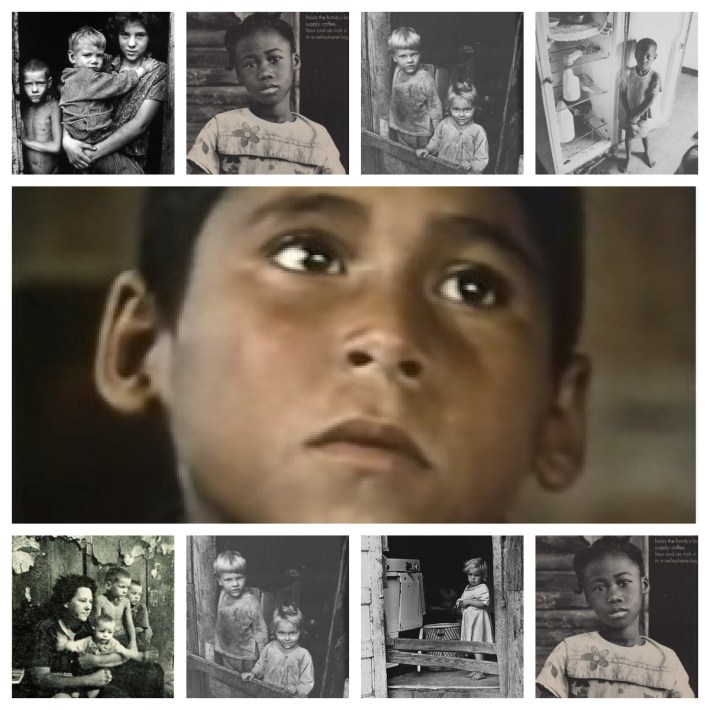
Starting tomorrow, we are going to have hungry kids in America.
This has never been acceptable in my lifetime.
Ever.
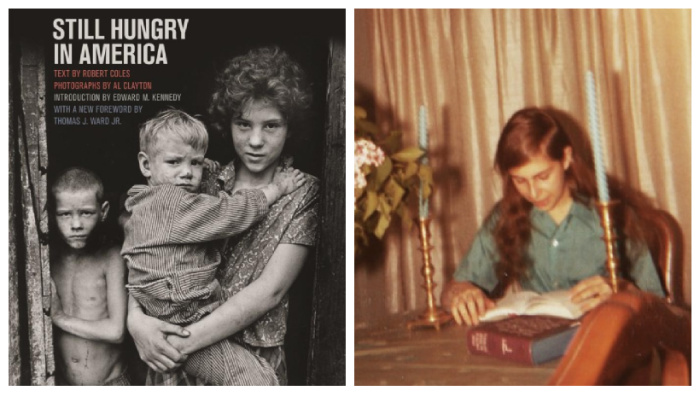
Hunger was a big issue for me when I was 16.
My struggle with anorexia was just a part of it. Despite my own constant hunger pangs, ones I clearly chose and chose to ignore in my disordered thinking, I was deeply troubled at the thought of those who suffered from real hunger pangs, those children in poverty who went hungry in America.
It was such a compelling concern of mine that when it came time for me to be Confirmed I chose to talk about Hunger in America in my speech to the congregation. In Reform Judaism, the ceremony of a Confirmation is a public affirmation and celebration of one’s commitment to Judaism, Jewish values, and social justice.
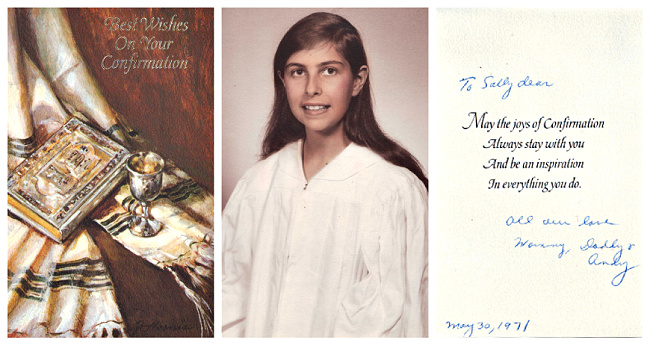
In May of 1971, I stood proudly on the bima ( podium) of my suburban Temple dressed in a flowing white robe that concealed the polyester party-ready white tunic and hot pants that I wore beneath it.
I looked out at the crowded audience; the long pews were filled with smiling well well-nourished, and well-padded family and friends.
With butterflies in my stomach, I glanced at the seated rabbi, who nodded solemnly for me to begin. I spoke strongly but plaintively in my soft teenage voice, explaining that in this richest of all nations, in the midst of our post-war plenty, children were going hungry in America.
Charity, one of the basic principles of Judaism, compelled us to not look away.
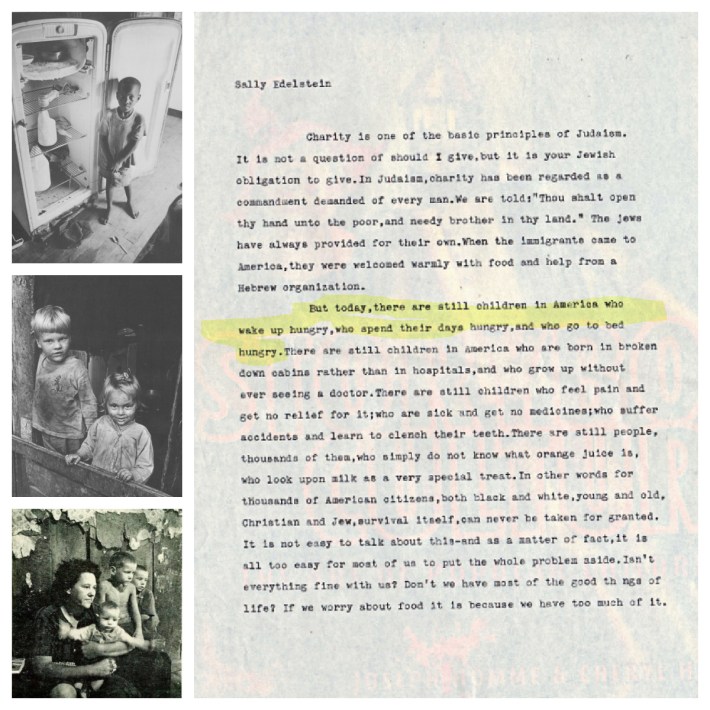
The speech I gave on Hunger at my confirmation May 30, 1971
“….But today there are still children in America who wake up hungry, who spend their days hungry, and who go to bed hungry….There are still children who….are sick and get no medicines who suffer accidents and learn to clench their teeth.”
“There are still people, thousands of them who simply do not know what orange juice is, who look upon milk as a very special treat. “
“In other words for thousands of American citizens, both black and white, young and old, Christian and Jew, survival itself can never be taken for granted.
“It is not easy to talk about this- and as a matter of fact, it is all too easy for most of us to put the whole problem aside. Isn’t everything fine with us? Don’t we have most of the good things of life?”
“If we worry about food it is because we have too much of it.…..”
CBS Reports Hunger in America
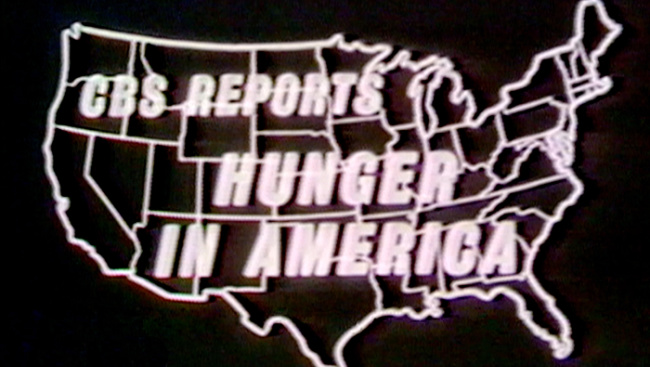
It was a TV documentary aired nearly 4 years to the day of my Confirmation that opened my eyes to this issue.
In May 1968, CBS aired its powerful documentary “CBS Reports Hunger in America.”
It took this documentary to make the words “hungry in America” come alive.
It told the American people, as only television could, about the plights of some 10 million hungry people.
It shocked a nation.
“Hunger in America” brought the faces of hunger into the living rooms of the country and made the problem all too human.
The moving and horrible scenes of small children suffering from hunger, malnutrition, and related diseases that this country assumed had long been eradicated were filmed in the black belt of Alabama, the horse country of Virginia, the barrios of San Antonio, and the Indian Reservations of Arizona.
It goaded our nation to action to begin to feed its hungry. Hunger became a new focal point in political debates. Activists helped to reframe hunger as an urgent matter of economic justice, racial justice, and equality.
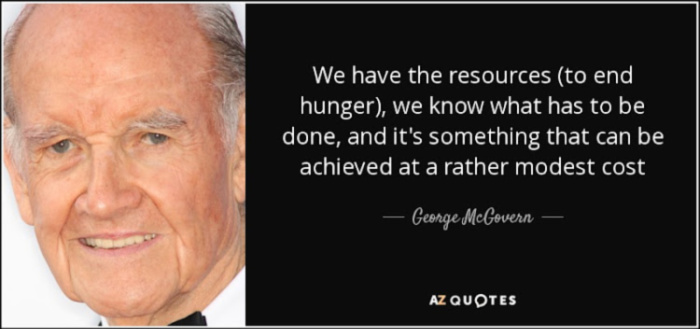
One of the most touching scenes in this CBS documentary motivated the late Senator George McGovern (D-SD) to become a leader in the fight against hunger
The camera focused on a boy, perhaps 10 years old, leaning against the wall of his school cafeteria, watching the other students eat lunch; the interviewer asks the boy what he gets to eat at school, and the boy says, “Nothing.” When the interviewer asks the boy how he feels watching the others eat, he says he feels ashamed, and when asked why, the boy answers, “I don’t have any money.”
Regarding that scene, McGovern later remarked, “I said to my family that was watching the documentary with me, “You know, it’s not that little boy who should be ashamed, it’s George McGovern, a United States Senator, a member on the Committee on Agriculture.””
Eradicating Hunger
By the end of 1969, politicians on both sides of the aisle embraced the idea that hunger could and should be eradicated in the United States. At the December 1969 White House Conference on Food, Nutrition and Health, President Richard Nixon made a “commitment to provide free or reduced-price lunches for every needy child in America.
McGovern would eventually go on to build a coalition with Republican Bob Dole to pass the 1977 Food Stamp Act, which established national standards for the program (now SNAP) and removed the requirement that recipients pay for stamps, dramatically reducing hunger in the U.S.
Shame
Today, a tone deaf President and Congress feel no shame in cutting off Food Aid to millions.
42 million Americans who depend on federal food assistance will be in danger of going hungry.
But American citizens are listening, and thousands are donating to food banks.
Let’s make sure we all fill others’ stomachs and hearts.
© Sally Edelstein and Envisioning The American Dream, 2025. Unauthorized use and/or duplication of this material without express and written permission from this blog’s author and/or owner is strictly prohibited. Excerpts and links may be used, provided that full and clear credit is given to Sally Edelstein and Envisioning The American Dream




 Envisioning The American Dream
Powerful piece. I’m curious, how did the rabbi and the congregation react to what you were saying? I’m sure this was not something they expected to hear about at a confirmation.
LikeLike
Thanks. Not surprisingly I had saved a folder full of everything related to my confirmation ( ergo I had the typed speech) and included in the memorabilia was a letter from the Rabbi thanking me for a gift I apparently gave him. At the end he wrote a PS congratulating me on my excellent speech and saying people really were moved.
I do know my mother was very proud and I certainly must have shared it with her after I wrote it. At the time I aspired to work for VISTA so she was not suprised at the content.
LikeLiked by 1 person
You had your finger on the pulse of America at a very early age. Had your chosen path as an artist not have been so strong we wonder: Would you be serving NY today in the House or the Senate?
LikeLiked by 1 person
That’s such a kind thing to say. I know I gravitated very early on to issues of social justice, which drew me to Bobby Kennedy.
LikeLike
The issue of the judicial ruling “null and void”. touching the Rambam, Tur, Shulkan Aruch, and the whole of Orthodox Judaism which bases halacha upon Roman statute law, does the halachic posok of statute law qualify as Oral Torah?
Answer: No it does not. The Karaim because they had no פרדס logic system had to create their own interpretations. For example: having visited a Karaite bet knesset in the Old City of Jerusalem I saw with my own eyes their version of the Torah commandment mezuzah. The Karaite religion makes the Xtian 10 commandments as their mezuzah. No that’s not the mitzva of mezuzah any more that the Rambam, Tur, or Shulkan Aruch codes of halachah compare to the Talmud as the Oral Torah.
A complex issue related to Jewish law (halacha) and its interpretation. Basically what’s at issue, the distinctions and differences between judicial common law which has legislative review veto and overwatch of any and all statute laws passed by any Parliament, Congress, President or king. Specifically, statue laws passed by any government body do not equal nor compare to the authority of judicial common law rulings which have the power to not only annul a statute law, but can re-write the statute law such that the re-written judical legislative review new law meets the Constitutional requirements which the Courts so interpret and determine.
Judicial common law stands upon the foundations of פרדס, a kabbalah as taught by rabbi Akiva who learned this 4 part inductive reasoning logic from the P’rushim. The P’rushim preceded the rabbis of the Talmud. They fought a Civil War, remembered by lighting the eight lights of Hanukkah, and defeated the Tzeddukim assimilated and intermarried priests during the ancient Greek kingdom in Syria.
The Greek empire dates back to the time when Alexander the Greek conquered the Persian empire. Following Alexander’s death, two Greek kingdom’s one based in Alexandria Egypt and the other based in Damascus Syria. Both Greek kingdom’s went into decline as the Roman empire’s star rose. Cleopatria VII ruled as the last Queen of the Ptolemaic Kingdom in the days of Julius Caesar and Mark Antony. Antiochus IV Epiphanes ruled the Seleucid Syrian Empire during the 2nd century BCE. He is known for his oppressive policies against the Jewish people, which led to the Maccabean Revolt.
This revolt, commemorated by the Jewish holiday of Hanukkah. Which remembers & celebrates the rededication of Ezra’s Temple in Jerusalem after the successful uprising against Antiochus’s rule. Pardes (פרדס), the kabbalah which the P’rushim taught to rabbis Akiva, Yishmael, Yossi Ha’Galilee – basically all rabbinic opinions expressed throughout the 20 volume Talmud: This refers to a methodology of Jewish interpretation that consists of four levels of understanding: Peshat (simple meaning), Remez (hinted meaning), Drash (interpretative meaning), and Sod (secret or mystical meaning).
Pardes inductive logic – foundational to Talmudic reasoning. Pardes inductive logic stands on the opposite, so to speak, pole of Greek – Plato & Aristotle’s – 3 part syllogism deductive reasoning system. The assimilated Tzeddukim directly compare to the later Karaite Jews, in that both sects rejected the Oral Torah Pardes logic format. Both sought to replace Pardes inductive reasoning with Greek deductive reasoning to authoritatively interpret the intent of Torah commandments.
For example the Roman New Testament relies upon Greek logic to interpret T’NaCH verses that the Oral Torah Pardes logic system would never permit. The contrast between judicial common law and Greek/Roman statute law parallels deeper philosophical discussions about authority and interpretation within Jewish tradition. The historical struggles between different methodologies and influences shaped the legal and religious landscape, influencing how Jewish law understood and practiced through more than two millennia, since Moshe Rabbeinu first instructed Israel in this unique prophetic mussar legal system.
Justice Justice pursue defines the “FAITH” of Torah common law. Greek rhetoric by stark contrast employs theology and cults of personality as the basis of how the ancient Greek City State of Athens ruled the mob “democracy” of that particular ancient Greek polis/City State. The assimilated Tzeddukim Jews abandoned or “forgot” the Oral Torah which sparked the Hanukkah Civil War. Like the Xtians seek to convert Jews to believe in their 3 part Nicene Creed Gods so too the Tzeddukim sought to convert Jerusalem into a Greek polis and accept the Greek syllogism deductive reasoning as “the Way” (like Jesus described himself as such) to understand the T’NaCH.
LikeLike
Continuing our study of the Gemara of Kiddushin. משנה תורה אב משנה, סוגיה ב’ — מניינא דף ג
Understanding the basics of Oral Torah a fundamentally required absolute. Wrote of rabbi Akiva’s רבוי מיעט compared to rabbi Yishmael’s כלל – פרט, פרט – כלל middot by which both men interpreted through different sh’ittot the kabbalah of פרדס inductive logic reasoning. Clearly neither Boris Badenov, nor his boot licking sidekick Natasha Fatale (Rambam & Yosef Karo) understood the distinctions which separate Torah common law from Roman statute law.
ולרב הונא דאמר חופה קונה מק”ו. למעוטי מאי? למעוטי חליפין. ס”ד אמינא הואיל וגמר קיחה קיחה משדה עפרון, מה שדה מקניא בחליפין, אף אשה נמי מקניא בחליפין. קמ”ל. This “משל” term “קמ”ל”, what defines its נמשל interpretation? The Gemara asks: למעוטי מאי? Hence, our Gemara contrasts rabbi Yishmael’s midda of ק”ו against rabbi Akiva’s midda of רבוי מיעט. When ever encountering a קמ”ל, this משל teaches the נמשל of either a רבוי מיעט. A fundamental chiddush, how to correctly read the Talmud with an understanding discerning eye – comparable to the tongue of a wine bibber. The Talmud defines understanding as: discernment like from like.
The פרט of בראשית כד:ב requires research. Let’s open by making a מדרש רבה analysis. Midrash functions as a reference resource for Talmudic study. The flat assimilated Yeshiva education system totally ignores learning Talmud together with Midrash, a clumsy yet cunning schemer basic Snidely Whiplash error. Which utterly backfires in a pathetic shallow addiction to the Rambam error of literal word translation Orthodox Judaism religious stupidity.
בראשית רבה נט:ח – Midrash Rabbah connects this verse through the midda of גזירה שוה to כי יקח איש אשה. Avraham & servant Eliezer cut an oath alliance Torah common law legal precedent prototype. The hand-under-thigh Torah language refers to an oath sworn obligation through which the גזירה שוה equally applies to the קידושין oath brit obligation which obligates a Man to give a get to his ex-wife if he divorces her. What does the mitzva of קידושין acquire? The Nefesh O’lam Ha’Ba of the woman’s soul! Specifically learned from the Torah precedent בכל נפשך repeated twice in the opening first two paragraphs of the ק”ש. Bereishit Rabbah learns this critical גזרה שוה, as a critical proto–common law precedent; a foundational legal principles or decisions that define the development of Oral Torah common law as we know it today.
The רבוי מיעט – The acquired “wife” does not lose her independent da’at. Kiddushin-betrothal does not confer ownership over the woman, her various aspect: such as her body, labor or personhood. She exits marital status through get, not resale. Never does she qualify as ממון: money, valuable possessions, and property. Herein interprets the k’vanna of the language of our Av Mishna, which does not say: האשה נקנית לאיש, but האשה נקנית בשלש דרכים — the mitzva of קידושין separates this woman from all other women. Herein understand how the gospel Av tuma avoda zara touching the vile story of virgin birth follows Greek mythology of Hercules rather than Oral Torah common law.
The precedent of Avraham and his servant sworn oath, this Torah brit alliance obligates. Hence this Torah precedent critical in understanding the mitzva of קידושין as an oath alliance brit obligation which obligates both Man and Woman equally. קידושין acquires exclusive – מיעט – over the woman’s nefesh-standing vis-à-vis other men. Herein explains why adultery qualifies as a Capital Crime case which only a Sanhedrin court can adjudicate. Hence no Goyim court qualifies as having authority to issue a divorce. This fundamental recognition that only Torah courts shall determine “the Jewish Problem”, as expressed through the post Shoah oath: NEVER AGAIN.
Oral Torah does not function as a תולדות commentary on the Written Torah —Oral Torah common law derived from precedent תולדות positive and negative Torah commandments. קידושין acquires a brit-level oath obligation as a Av Torah time-oriented commandment. This oath alliance obligation establishes enforceable duties such as כתובה, גט, & fidelity. This mitzva does not treat the acquisition of a wife comparable to how a man acquires ownership of a עבד כנעני; the concept of “soul” understood as title acquired to all future born children fathered consequent to this קידושין. This Torah mitzva serves to amplify the k’vanna of swearing an oath alliance לשמה – the first Sinai commandment; the greatest commandment in the revelation of the Torah at Sinai.
ולרב הונא דאמר חופה קונה מק״ו
למעוטי מאי
למעוטי חליפין
This question cannot be asked within Rabbi Yishmael’s כלל–פרט system alone, because: A pure ק״ו would expand; a pure גזירה שוה from שדה עפרון would import all kinyanim. Hence the danger: ס״ד אמינא:
הואיל וגמר קיחה קיחה משדה עפרון
מה שדה מקניא בחליפין
אף אשה נמי מקניא בחליפין
This while logically correct under Rabbi Yishmael’s sh’itta. But rabbi Akiva’s קמ״ל = רבוי מיעט, not כלל–פרט. So קמ״ל here teaches the negative boundary of the רבוי, just as it likewise understands the relationship between Shabbat to Chol! A very important precedent since the mitzva of shabbat critically defines: HOLY; just as korbanot dedications define the kingship mitzva of Moshiach. Moshe anointed the House of Aaron to dedicate the nation to pursue righteous judicial justice. The prophet Natan cursed the House of David with eternal Civil War after he failed to rule with justice in the matter of the baal of Bat Sheva. Just as Aaron did not offer up barbeques to Heaven through korbanot, so to the Moshiach does not rule as king if he fails to establish righteous common law Federal Sanhedrin courts!
Acquisition to the “title” Nefesh O’lam Ha’ba of the woman’s soul does not compare to buying or selling chattel. Reading the Talmud as if it compares to the novel of a Harry Potter NT false messiah – Protocols of the Elders of Zion fraud-literalism, destroys and uproots precedent-based Oral Torah common law/משנה תורה. Rabbi Akiva’s kabbalah of פרדס inductive logic, ancient Greek syllogism deductive logic simply does not work any more than does the Yad, Tur, or Shulkan Aruch assists students to correctly understand how to study and learn the Talmud. Hence the sages codified in the Talmud referred to as “Oral Torah”, whereas the Rambam Yad in no way, shape, manner, or form qualifies as Oral Torah. The two systems compare to the Planets of Mars and Venus.
The קמ”ל always signals רבוי–מיעט. In this particular case: it excludes chalipin, despite the valid ק״ו logic. Because the acquired object – a brit obligation over the “nefesh” soul. Which likewise the Oral Torah differs from the Yad, Tur, Shulkan Aruch counterfeits, the acquisition of “nefesh” simply not ממון, but rather the future born children – the definition of the first Torah commandment: be fruitful and multiply. The רבוי מיעט of the קידושין acquisition of “soul”, separates Goyim from the chosen מיעט Cohen people created through the Av tohor time-oriented Torah commandment of קידושין. Which aligns perfectly with Bereishit Rabbah’s oath-alliance precedent.
The concluding statement of מדרש רבה נט:ח — א”ר יצחק חטיא דקרתך זונין זרע מנהון. Rabbi Yitzhak stated: ‘The wrongdoing of your actions prevents their sustenance from coming;’ restated: “produces continuity only when obligation is preserved.” This closing statement of Midrash Rabbah נט:ח functions as a juridical boundary marker – informing how legal drosh “borders”; the Tosafists reasoning perhaps qualifies it as הלכה למעשה. My sh’itta of inductive reasoning argues the comparison between the case of our Gemara — to the case introduced by Midrash Rabba (the definition of inductive vs deductive reasoning) – do not interpret the קידושין oath brit alliance as the acquisition of an object but rather as the very definition of creating the chosen cohen people through tohor time-oriented commandments.
Torah common law draws category boundaries, such as Sanhedrin courts only have legal jurisdiction within the borders of Judea. Or prophets serve as the police enforcers of judicial common law legal rulings; if no Sanhedrin courts then likewise no prophets. Despite the koran narishkeit which declares that prophets sent to all peoples across the Planet and the Arabs the last people on Earth to receive their “chosen” prophet; hence their absurd declaration that Muhammad was the last of the prophets!
חליפין has the legal meaning which presumes חפץ – a thing. ‘Fungible goods items’ qualify as horse-trading, interchangeable goods. Fungibility facilitates easy transactions and exchanges. Representative by contrast refers to something or someone who stands in for or symbolizes someone or something else. Like Representatives voted into the Federal Congress, they serve as proxies for the voting electorate within any given US State. In basic horse-trading, money functions as a representative of legal trade instead of barter. A common custom practiced by Goyim societies: wife swapping.
Torah law never universalizes categories without jurisdiction. This fundamental מאי נפקא מינא – רב חסד middah forever separates Torah common law from Islamic (and Christian) universal-prophetic claims, which erase jurisdictional boundaries entirely.
Kiddushin cannot tolerate representation … wife swapping. A nefesh cannot be substituted; brit cannot be “grafted” to Goyim who do not and never have accepted the revelation of the Torah at Sinai. Fidelity cannot be symbolically reassigned; the Torah oath brit which creates the chosen Cohen people defined to Talmudic established culture and customs, personal, exclusive, & non-fungible. The Torah phrase “והיו לבשר אחד” — not metaphysics — rather anti-fungibility common law. Therefore חליפין utterly treif in the matter of קידושין because it baptizes brit into a substitute theology exchange which replaces the pursuit of justice as faith for belief in some theologically created new God as faith.
The mitzva of קידושין rejects the Goyim custom which perceives marital bonds as transferable; persons as interchangeable units; relationships as revocable exchanges which defines the legal concept of fungibility in human marital relations. Therefore our Gemara blocks that endpoint at the root by excluding חליפין. Herein our Gemara separate kiddushin from market place logic of acquisition of goods and property.
Therefore, קמ״ל in Kiddushin functions as a רבוי–מיעט marker: it affirms that Kiddushin functions as a true kinyan, while excluding any kinyan whose logic presumes fungible object-ownership; therefore חליפין – excluded because brit over nefesh cannot be represented, substituted, or exchanged.
LikeLike
Compare and Contrast the key to discerning truth from false.
Joseph Smith’s teachings emphasize that humans are literal children of God and that they have the potential for eternal progression, suggesting a close, personal relationship with the Divine. The mention of “Av tuma avoda zara” refers to the concepts of impurity and idolatry in Jewish tradition.
The distinction between the names of God (like El, Elohim, El Shaddai) that characterize God’s presence in a more transcendent manner, and the concept of the Divine Presence as found within the hearts of the chosen people (Yatzir Ha-Tov) post Sinai Revelation, reflects a vision, a perspective that emphasizes that HaShem dwells within the hearts of Israel rather than in the Heavens above as Xtian and Islamic theologies preach. The concept of “chosen Cohen people”, represents the Central Theme of the Torah starting with the rejection of the first born son Cain’s sacrifice in favor of his younger brother’s sacrifice.
This theme repeated throughout the Torah, from Yishmael rejected in favor of Yitzak, to Esau rejected in favor of Yaacov to the struggle between Reuven vs. Yosef and the rejection of all first born children of Israel in favor of the Tribe of Levi.
Av Tuma avoda zara has no consciousness NOT of tohor/tuma spirit distinctions – absolutely critical for a man to discern Yatzir Ha-Tov tohor middot spirits from Yatzir Ha-Raw tuma middot spirits — both of whom wrestle within the heart for dominance like as did Esau and Yaacov in the womb of Rivka. Av tuma avoda zara religions minimize the fundamental revelation of the Torah which exposes that HaShem lives within the tohor middot of the Yatzir Ha-Tov within the heart; and not in the Heavens above.
Smith’s theology preaches of worlds separate and above this world. A completely foreign addition which the Torah rejects. All av tuma avoda zara theologies, Xtianity and Islam serve as two classic examples, emphasize some Monotheistic Universal God’s omnipotence away from the Human soul. This openly rejects the Talmud instruction which teaches that only the 12 Tribes of Israel accepted the Torah revelation at Sinai, as explained above. HaShem – a local tribal god. Not a Monotheistic Universal God. Hence the revelation of the 2nd Sinai commandment against the worship of other Gods.
Idolatry exists as a corrupt translation of avoda zara. The T’NaCH and Talmud define the latter as 1) assimilation to customs of peoples who reject the Torah revelation at Sinai 2) intermarriage with Goyim, who by definition reject the revelation of the Torah at Sinai. Goyim limit “idolatry” to graven images! Clearly the two opposing ideas – not the same or even similar to one another. Joseph Smith’s teachings about separate worlds and heavenly realms introduce notions that are foreign to the Torah. The commandment to build the Mishkan/Temple differentiates form from substance. The substance of faith, expressed through the pursuit of righteous justice among our bnai brit allies, that our local tribal god lives within our hearts as a brit people. Av tuma avoda zara totally oblivious to this fundamental Torah revelation.
LikeLiked by 1 person
The unique Av tuma avoda zara of both Xtianity and Islam.
The Torah describes Molech as a specific form of Avoda Zarah. The manner of worship of worshipping that God, passing children “through fire”, as a ritual act to that deity. Halacha does not treat “any religion that includes suffering, death, or sacrifice” as Molech. Actual ritual human sacrifice – a physical act performed as a cultic offering.
Xtianity worships JeZeus as the son of God and part of the Nicene decreed Trinity. This theology depicts the brutal murder of JeZeus by way of torture, brutality, and slow death on the cross as a “Sacrifice to atone for Original Sin which condemns all Mankind to Hell”. Clearly the church never identified the Gospel “Father” with Moloch or any other specific “other God”.
Xtianity does not practice human sacrifice, but it does practice hate toward “Christ-killers” throughout its entire history as the dominant religion of European societies – Universally – almost all European Xtain countries practice dogmatic hatred against Jews through the worship of blood libels, pogroms, taxation without representation, ghetto gulags and WWII Shoah.
Molech worship, defined by a very specific ritual. Obviously Xtianity does not fit this model exactly for any person to affix the “Father” to JeZeus son of God. Halacha never equates Xtianity with Molech, that’s a known historical fact. The Talmud analysis of avoda zara does not address the mythological Gods of Mt. Olympus; any more than it does the theological dogma known as the Nicene Creed of the Trinity, or the Muslim tawhid creed of strict monotheism.
The church imposed a Devil hatred worship, akin to the bi-polar Good/Evil Gods of Zoasterism – toward Jews. Both Priests and Pastors promoted this Satan hatred as their worship of their God. This does not affix Xtianity as a Zoasterism faith, anymore than its worship of the cult of JeZeus sacrifice upon the Cross qualifies as the worship of the God of Moloch!
Medieval Xtian theology emphasizes a moral dualism (God vs. Devil) and often employed demonization of Jews in preaching and polemics. As such Xtian theology cast Jews as demons of Satan and other such negative slander. This criminal “mass insanity” defines the crimes committed against the Jews of Germany during the first Crusades, and the repeated forced mass population transfers from one European country to another.
The Talmud in Baba Kama’s opening Mishna teaches of 4 Avot\archetypes of Tam (damagers without intent). The teaching style of Oral Torah require that the reader him/her self make the logical inference. Oral Torah interprets the k’vanna of wisdom commandments, known as “time-oriented mitzvot”. The 3rd Book of the Torah defines korbanot as “time-oriented commandments”. Consequently if 4 archetypes of Tam damagers then logically also 4 Avot of Mu’ad (intentional damagers) – theft, oppression, incest, and bribing judges to corrupt a court ruling. Theology, politics, social scapegoating, mob slaughter of Jewish communities/Inquisition etc qualify as specific historical examples that come within the 4 Avot archetypes of mu’ad damagers.
Incest (boundary violation), a metaphor for violating the most intimate self identity of Jews; like baptizing children against the will of their parents; forced conversions, erasure of identity, spiritual violence etc. The Church – both Catholic and Protestant – branches purposely crushed despised Jewish refugee populations as an act of worship of their unnamed “Father” of JeZeus God in heaven. Xtianity’s “Father” not not Molech, not Zoroastrianism, not halachically human sacrifice. Therefore I don’t need to call your God Molech to say the church worship of their unnamed “Father” God in Heaven resembles other religions of avoda zara in multiple and many ways.
Post Shoah no exoneration. 2000+ years of Pie in the Sky – where was JeZeus during the Shoah. Where was Allah during the disastrous Arab and Muslim defeats post the victory of Jewish national Independence in ’48 and ’67? Molech: a narrowly defined avodah zarah; Xtianity does not fit that ritual model. Our Sages, of blessed memory do not map out Olympus, Nicene Trinitarianism, or Islamic tawhid by name; they give categories, not a catalog. The way you worshipped your God, and the culture you built around that worship, resembles avodah zarah in its effects and its moral structure—even if halacha doesn’t technically classify it as Molech or Zoroastrianism. Based fundamentally upon the gospel rebuke of: “By their fruits you shall know them”. Whatever you call your “Father” God, the avodah that produced those fruits cannot be called righteous. History itself judges the worship of your Gods as false.
What your theologies promote for Xtians or Muslims to believe – pie in the sky nonsense. What have both the Church and Mosque done? What did your God-jabber theology/creeds license “believers” to do? Drop your slogans and propaganda rhetoric and your emotions on your sleeve, history judges your Av tuma faith by the crimes of its fruits.
LikeLike