


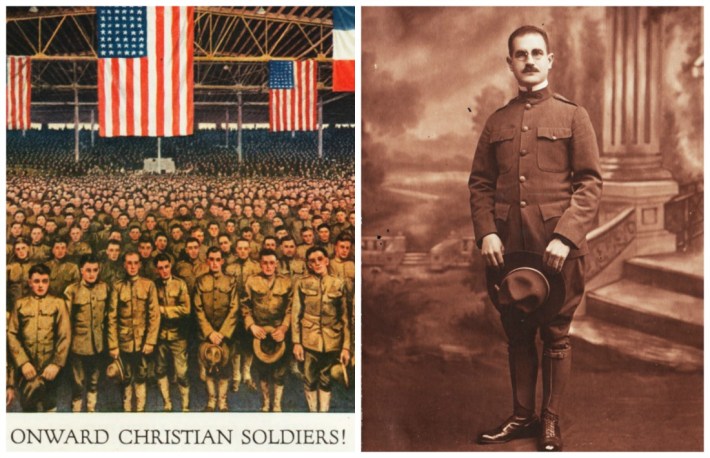
As America entered the Great War in 1917, Uncle Sam encouraged all his “hyphenated” American nieces and nephews to join him in fighting this war to end all wars.
While we celebrate Veterans Day, and the anniversary of Armistice Day, the shadow of anti-Semitism still casts a dark cloud over us. It is worth remembering that approximately 225,000 Jewish-Americans served proudly in WWI.
Among them was my Jewish maternal grandfather, Arthur Joseph.
It was with great pride that, a few years after the signing of the Armistice, Arthur and his wife, my grandmother Sadie, listened as his former Commander, General John Pershing, Commander of the American Expeditionary Force, delivered a stirring speech extolling the value of Jewish servicemen. The speech was given in 1926 in the majestic halls of the great Gothic Cathedral of St. John the Divine in upper Manhattan at an interfaith meeting to aid the suffering of Jews in Eastern Europe.
“ When the time came to serve their country under arms,” General Pershing said, “no class of people served with more patriotism or with higher motives than the young Jews who volunteered or were drafted and who went overseas with our other young Americans.
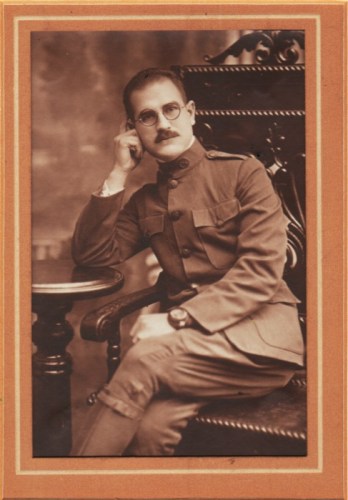
To Make the World Safe for Democracy, my grandfather served with dignity as an American and as a Jew. A second-generation American, he was born in N.Y.C. to Hungarian immigrants who had lived in the country for over 25 years.
But he was always a Jewish-American.
There was still resistance to the “hyphenated” Americans despite the fact that nearly a quarter of the men sent to fight in Europe in 1918 were foreign-born. Many had only arrived from Ellis Island months or years earlier when they enlisted.
By the time of the war, the melting pot was roiling.
With one in three Americans in 1918 either born abroad or of foreign-born parents, resentment of immigrants became part of the Great American melting pot recipe. The idea of hyphenated American citizens who identified as Italian-Americans or Jewish-Americans made many native born citizens uneasy.
Terms like yid, kike, mick, dago, and polack were tossed around as casually as baseballs.
Former President Theodore Roosevelt encouraged the suspicion of hyphenated Americans, insisting that all citizens, no matter their birthright or ethnic heritage, should embrace “the simple and loyal motto America for Americans.”
Sound familiar?
Immigrants, along with Jews, would prove critical to the country’s effort in WWI. Despite their importance, America closed its borders in the years after the Armistice, ending what had been the largest immigration flow in the country’s history.
With American Jewish participation in WWI, Rabbi Stephen Wise wrote optimistically in a 1917 N.Y. Times op-ed that military service would “ mark the burial, without the hope of resurrection, of hyphenism and will token the birth of a united and indivisible country.”
A dream that is clearly unrealized.
It’s time to call an armistice to the hate of the Other.
© Sally Edelstein and Envisioning The American Dream, 2025 Unauthorized use and/or duplication of this material without express and written permission from this blog’s author and/or owner is strictly prohibited. Excerpts and links may be used, provided that full and clear credit is given to Sally Edelstein and Envisioning The American Dream with appropriate and specific direction to the original content.



Amen. And thank you for your service,
Joesph.
LikeLiked by 1 person
Thanks
LikeLike
What an excellent re-cap of the history of the US at the time of WWI and the place American Jews and other not so recent immigrants held. Your family story continues to fascinate me.
LikeLiked by 1 person
Seeing my family through the lense of history is something that has always informed me and I’m glad you enjoy reading it.
LikeLike