


Collage by Sally Edelstein
About Envisioning the American Dream
Envisioning The American Dream is a way of seeing the present through the prism of the past.
For more than fifty years, I have collected the paper trail of the American Dream. My home is filled with vintage advertising, catalogs, booklets, magazines, photographs, brochures, schoolbooks, cards, workbooks, comic books, and illustrations—all remnants of our American consumer culture that helped define the American Dream and the possibility of its attainment.
How was the idea of the American Dream created, shaped, and sold to us, especially in the mid-20th century?
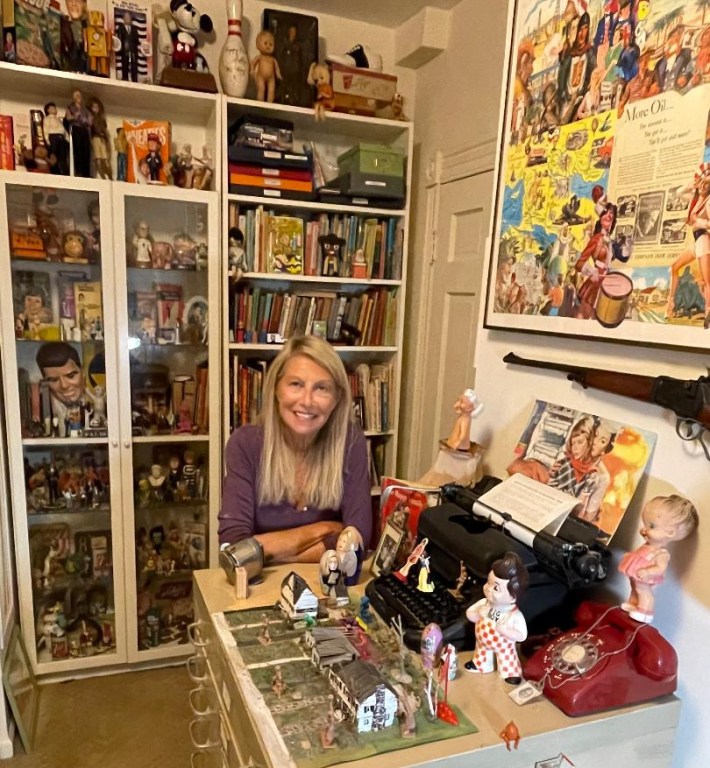
As a visual archeologist, I dig deep into American mythology, excavating the social fictions society has told us over the past eighty years. As artifacts of everyday life, most ephemera are doomed to disappear. I see myself as a guardian of our collective past. Preserving the past gives us information for the present.
An amalgam of personal narrative, history, and social commentary, Envisioning the American Dream looks at the ways advertising and media steer our perceptions of race, class, gender, and national identity. I relate current events to past ones, often bringing little-known history into the mix to suggest a different perspective.
The American Dream: Created, Shaped, and Sold
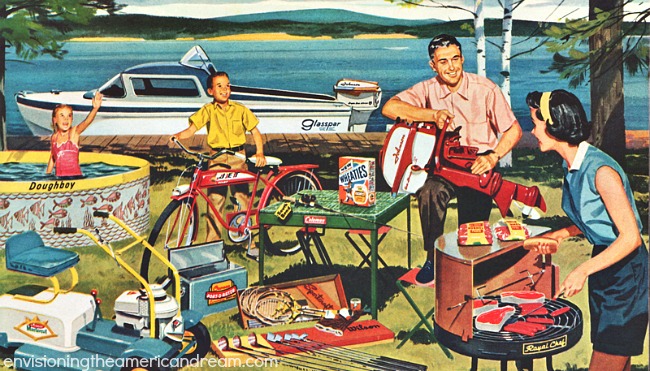
Advertising and popular culture are not simply illustrations in this work.
The images are the sharpest renderings not of reality, but of domestic and national ideals. They may be laughable and seemingly insignificant, but at the same time they are powerful enforcers of gender and racial stereotypes. They are evidence, revealing what Americans were encouraged to desire, fear, buy, and believe about family, class, religion, patriotism, and the American Way.
From the New Deal to the New Frontier and beyond, Americans were sold a seductive story about themselves. It was a heady time when government, technology, big business, and science were seen as positive forces that would help us move forward toward achieving the American Dream.
Moving forward at ever-increasing speed was what Americans expected from their country, their cars, their consumer goods, and their economy. Americans were the envy of the world.
Mid-century America churned out myths with the same speed it did Chevrolets.
Skillfully weaving fairy tales along with the Brothers Grimm, the real Mad Men of Madison Avenue spun a yarn or two themselves.
These images offer a mirror to the once-upon-a-time American Dream, presented by a media calculated to sell that dream to the world—and to ourselves.
That buoyant optimism stands in sharp contrast to the diminished expectations and downsizing we are living with today, as the American Dream fades like a once-cherished Kodacolor snapshot.
The Object is Only the Beginning
An essay may begin with a 1957 Frigidaire advertisement, a Barbie Dream House, a frosty bottle of Tab, a Winston cigarette commercial, or an old Dick, Jane and Sally primer.
But the object is only the beginning.
An old pink can of Metrecal diet food might lead me into the history of eating disorders. A black-and-white childhood snapshot of me in my suburban backyard sporting my gen-u-ine Roy Rogers holster and toy gun can open onto America’s changing relationship with guns and our epidemic of school shootings. A fading advertisement for suburban abundance can reveal who was—and wasn’t—invited into the American Dream, and who is still excluded today. A third-grade civics book from 1963 can serve as a way to ask what happened to the democratic ideals I was taught as a child.
The Past isn’t Past: America’s Cultural Fallout
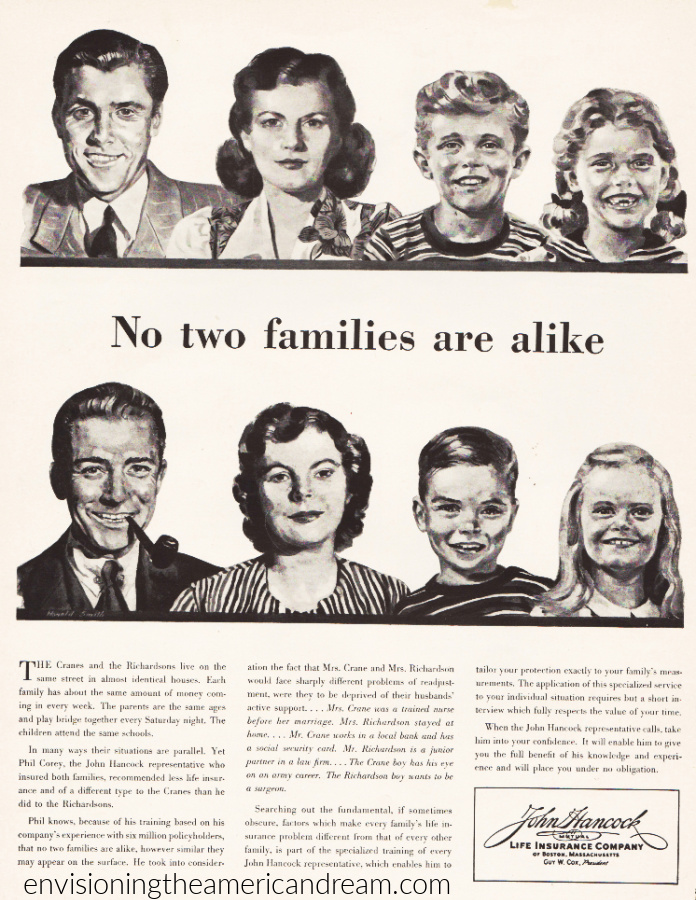
“No two families are alike” announces the headline to this mid-century advertisement from 1947. Yes, there is great diversity in America the ad seems to imply … that is, as long as you are white, middle class, and Protestant. How much has really changed?
These advertisements may have yellowed, and the textbooks may have grown musty, but the ideas they sold us have proved remarkably durable.
Fossilized remnants are everywhere.
They can be found in today’s arguments about the size of women’s bodies and the renewed fantasy of the trad wife; in our ideas about race and whiteness, about who belongs and who doesn’t; in the products we believe will magically transform us; in our assumptions about family, class, gender and success; and in the increasingly fraught question of what it means to be an American.
History, memoir, advertising, politics, current events and popular culture collide here, accompanied by a healthy dose of irony.
Rummaging Through America’s Attic
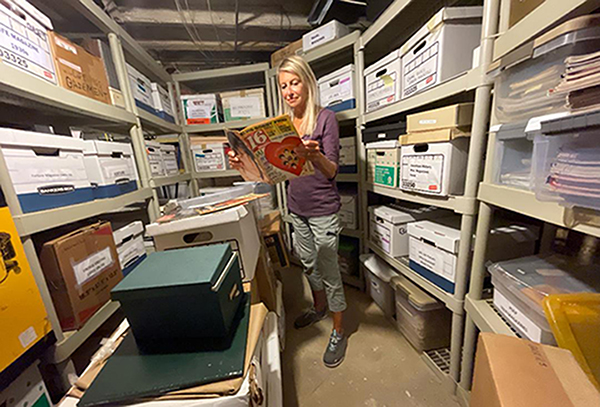
After more than 1,000 illustrated essays, I’m still rummaging through America’s attic, looking at the things that are part of our collective consciousness and asking what they can tell us about the country we’re living in now.
Because the past isn’t past.
Its cultural fallout is all around us.
Just like all the wonderful paper that clutters my home.
About Me

Living in Tomorrow
Of all the fairy tales I grew up with, the ones about the American Dream would turn out to be the best fairy tale of all
I would grow up living in the tomorrow that was my parents’ post-war American dream.
Born in the afterglow of Hiroshima, I had missed WWII by a decade, the Depression by more than two, and the New York World’s Fair with its technological wonders of the future by fifteen. In a child’s mind, that was an eternity.
But none of it was ancient history in my house.
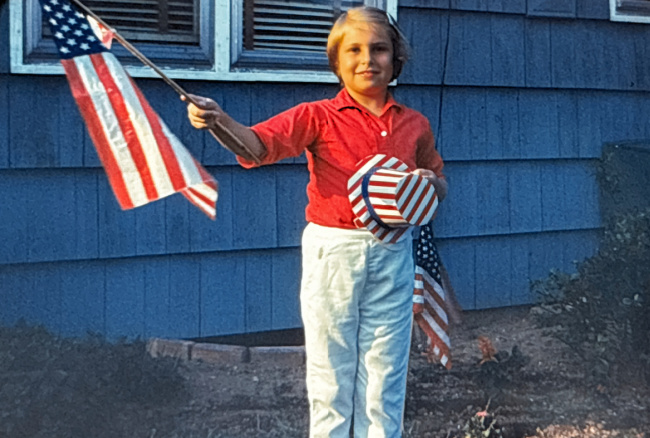
July 4, 1962 Sally Edelstein in her suburban backyard.
My parents carried those experiences—and the buoyant faith in America that followed them—straight into my childhood. The confidence was infectious.
I would be the happy recipient of their abundance.
Nothing personified that dream more than our suburban home on Long Island, New York, where my parents lived for nearly sixty-two years. My foundation was entrenched in that home, so it should be no surprise then that my interests are rooted in that time and place.
That suburban dream that had sprung up in a field of potatoes was their Promised Land, one that beckoned millions of postwar pioneers, including my parents.
Duck and Cover
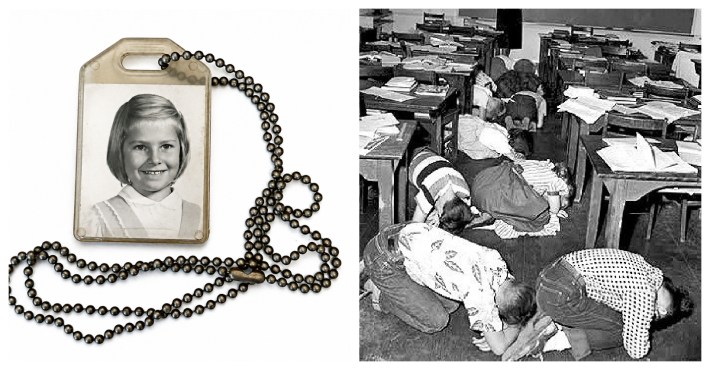
My Cold War Duck and Cover Childhood Civil Defense Plastic ID to wear in case of nuclear attack.
Postwar optimism lived side by side with the very real fear of nuclear annihilation, and I caught a Cold War chill that would chase me my whole life.
For those of us growing up in the 1950s and ’60s, duck-and-cover drills and the possibility of nuclear attack were the subtext of childhood. The fallout from the atomic bomb had a long reach, scattering its toxic fear all the way to the suburbs of Long Island.

While other girls my age coveted a Barbie Dream House in 1962, I longed for a home fallout shelter. It was one of the great disappointments of my mid-century childhood that my family never had one.
MAD, Mad Men and Happy Housewives
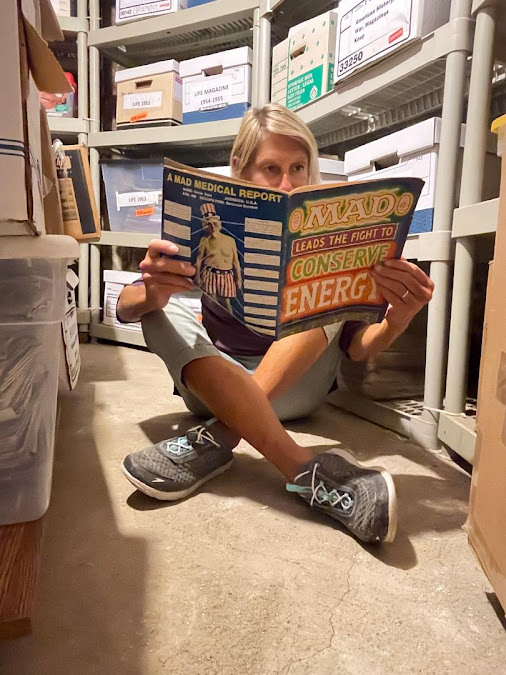
In a mid-century culture of mutually assured consumption and mutually assured destruction, it’s not surprising my own creative journey began with MAD.
If post-war America was churning out myths as fast as they did Chevrolets, MAD just as rapidly skewered them.
Growing up in the atomic age of nuclear families and nuclear jitters, Cold Warriors and hot wars, mad men and happy housewives, MAD’s cynical eye offered a road map for me to navigate this rapidly changing world.
A Feminist in Training
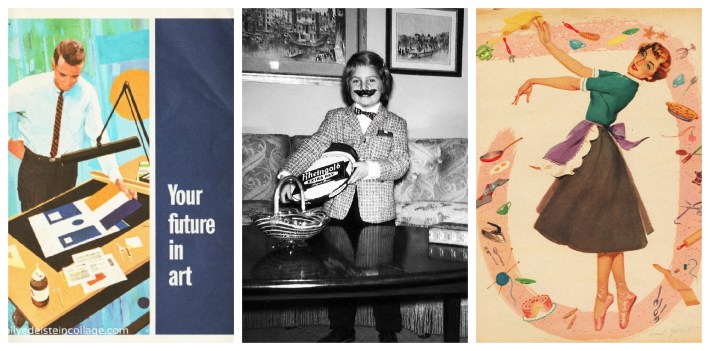
At 3 years old I chose to be known as Pierre a Parisian painter, forsaking the cookie cutter homemaker life I saw all around me.
My fascination with advertising began early
Despite growing up in the age of Mad Men, as a child I was more Don Draper than his wife Betty, The roots of my feminism were improbably seeded early.
As a child in the early 1960s living in the cookie-cutter post-war suburbs of New York, I was an artist from a young age. Resisting the pull to be a June Cleaver in training, by age three I insisted others address me as Pierre from Paris.
The portrayals of women I saw on television, schoolbooks, and in my mother’s magazines were all singularly white, living out the Lady Clairol world of carpools, cookouts, cream of mushroom soup casseroles, and catering to contented children and happy-go-lucky husbands. This held little appeal for me,
Since traditional roles, let alone marriage, were of no interest to me, it’s not surprising that as a little girl I never played house in the conventional scenario.
In 1963, I was a single working mom—at least a pretend one. I had no husband, nor did I have a boyfriend waiting in the wings. Besides, even in a fictitious world, between work and family, who had time for dating?
By second grade, I had moved into the corporate world. Among several imaginary enterprises I had created, I ran my own advertising agency, where I was the account executive, head copywriter, and art director rolled into one.
A Family Of Savers -And Saviors
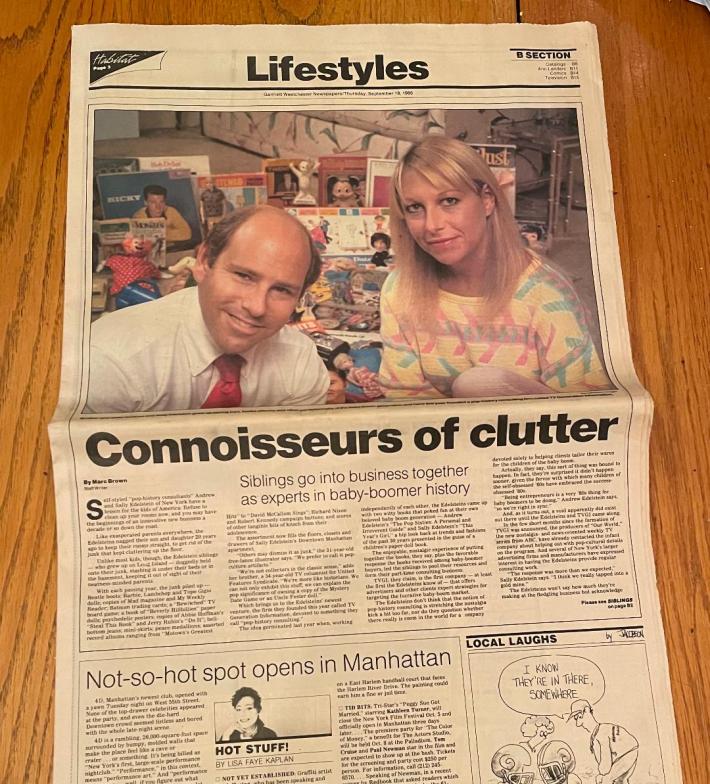
My brother Andy Edelstein, an editor at Newsday, and I ran a consulting business called “TV Generation Information,” advising companies how to market to baby boomers.
My collecting started early too. I come from a family of savers, though I prefer to think of us as saviors—guardians of things that might otherwise disappear.
The distant past is always as close as the things on my shelves and in my drawers. I love the history and information that surviving paper holds. A discarded advertisement, booklet, or schoolbook can reveal something about a time that we might otherwise never know.
There Were Strings
In the new and improved suburban world of split-level developments, mine would be a magical life, handed the great American Dream with no strings attached, beneficiary of all the previous sacrifices and scientific know-how, living out the East Coast suburban dream of plenty, sailing comfortably into easy retirement.
But there were strings.
I’ve spent much of my life examining them.
My Thought Process Is Collage
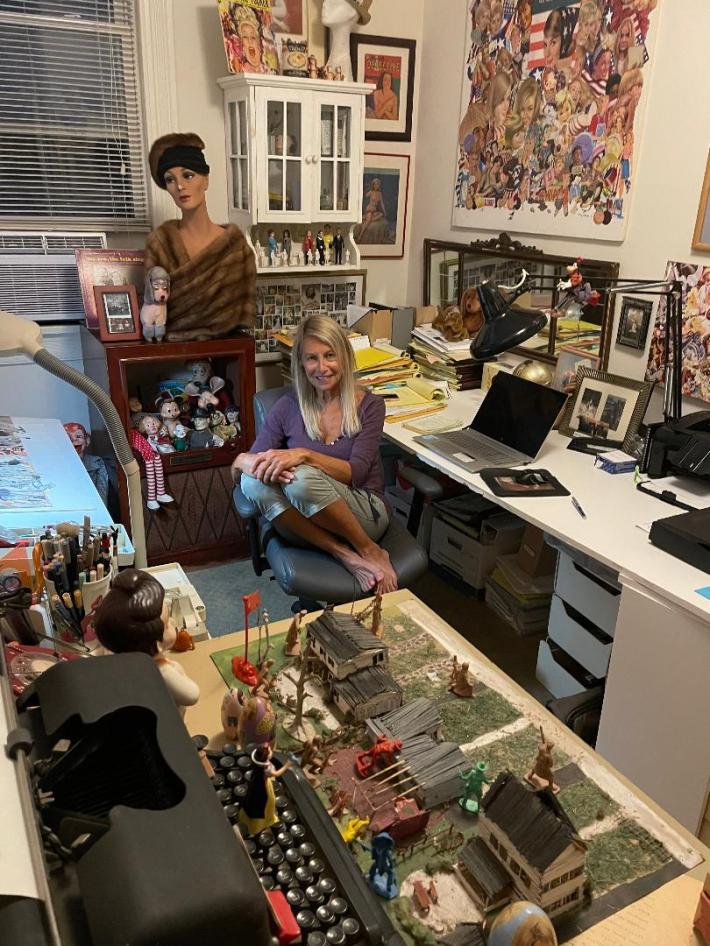
I’m Sally Edelstein—an artist, writer, visual essayist and incurable collector.
All these early threads eventually found their way into my work: the advertising, the Cold War, the happy housewives, the American Dream, the critical humor of MAD, the collecting and the instinct to question the stories I was told.
My thought process is collage.
I collect fragments—advertisements, photographs, memories, schoolbooks, artifacts, bits of history—and follow the connections between them. Sometimes they become a collage. Sometimes an essay. Sometimes a film.
Looking back over decades of work, the progression seems almost inevitable.
Painting led to illustration. Illustration led to collage. Collage led to writing. Writing led to film.
But I don’t think the work itself ever really changed.
Whether I’m working with a discarded advertisement, an old schoolbook, a collage, an essay or a film, I keep returning to the same question:
How do the images a culture creates become the stories its people believe about themselves?
The medium changes. The inquiry does not.
I have always been a storyteller.
I currently live on Long Island with my husband and our yellow Lab, Moe, who has found his way into more than a few of my stories.
Professional Bio • Exhibitions • Publications • Screenings & Talks
https://linktr.ee/sallyedelstein
Copyright (©) 20026 Sally Edelstein All Rights Reserved

 Envisioning The American Dream
Hello. What a great looking Blog and the memories it brought to me while capturing the American dream. I look forward to reading more!.
LikeLiked by 1 person
Has the American Dream traveled to China? Is China the new American Dream???
LikeLiked by 2 people
Choose one from column A one from column B
Sent from my iPad
LikeLiked by 1 person
Interesting. I grew up in Canada and am forever fascinated by the American dream. Canadians don’t have one. I think very few countries have the hubris/optimism to have one and name it.
LikeLiked by 2 people
Thanks for checking out my blog. Many of these American Dreams were propped up by myths, aided and abetted by Madison Avenue.
LikeLike
I just came about your website and find it very rich indeed. Actually, I’m working on teaching a course on women’s history from 1940-1980 but I also just finished teaching an eight week course on Postwar American Society, 1945-1960 to a class of 70 seniors at Osher Lifelong Learning Institute in Asheville, NC. In that course, I tried to dispel gently many myths about the American Dream as we covered the economic boom, the baby boom and the construction boom in addition to the politics of the Cold War and McCarthyism. I think many people realized by the end of the course that the 1950s was not the historical norm its been characterized as by Madison Avenue and the media, in general. But still, these myths about the great American dream die hard. Thank you for your good work!
LikeLiked by 1 person
Just started reading your blog…It will give me hours of fun having lived through a similar period on the other side of the pond with a slightly different perspective…the green tinged observer!
LikeLiked by 1 person
I just came across your website/blog and find it fascinating and very well done. You truly hit the heart of the American Dream, which has been sold to us by those whose interest it is to have us buy it all. Thank you for giving us a wonderfully retro look to some very serious issues. Keep up the great work.
LikeLiked by 1 person
Thank you Ginger, and I am so glad you came across my blog and enjoy it. It is gratifying that you appreciate what I am presenting. I hope you’ll continue reading.
LikeLike
This is my first visit to your blog, long on my to-visit list! I’m so glad to have found it. The whole notion of the “American Dream” is one that has always intriqued me, bringing on many discussions with friends of diverse circumstances. I look forward to reading more of what you are providing here! Thank you!
LikeLiked by 1 person
I’m so glad you enjoy the blog and appreciate your support.
LikeLike
Terrific! The amount of work, and the quality… Do you visit LoC irl and scan or take photographs? Or has LoC really digitized that much? Inspiring – here in Sweden there were issued a mandatory royal decree in 1661 by king Karl XI = Charles or Carolus XI – that specimen of everything printed were to be sent to the Royal Library – and later to the libraries of the universities too. But nothing much has been done with all this – one effort produced a book with newspaper clips from the 20th century, but that is about all. Maybe one ought to do something? Technical evolution makes it far easier and a lot cheaper to take copies – and in color too!
LikeLiked by 1 person
Thanks, glad you enjoy the blog. The images are all part of a private collection of ephemera I have collected through the years which I scan and clean up a bit.
LikeLike
Hi Sally, I’ve enjoyed reading your blog. Are you in print anywhere? I’m particularly interested as I’ve been using your work to help with a bit of research for some writing of my own.
A man from a small island somewhere out east (Britain).
Keith
LikeLiked by 1 person
Hi Keith
Glad my blog can be of some help for you. I am currently writing a book that will be chock full of information. What sort of research are you doing? Perhaps I can be of help in directing you to some sources.
Sally
LikeLike
Thanks Sally. Delighted to have happened on your fascinating site. Clearly lots to explore and reflect on. Regards from Thom at the immortal jukebox (plugged in and ready to play).
LikeLiked by 1 person
Glad you found the site Thom and hope you continue to enjoy it.
LikeLike
I was shocked to find sanity on the internet. Thank God there are still some people like you left….I was starting to wonder.
Well done….
—sage
LikeLiked by 1 person
It is a bit of the wild west out there, glad you enjoy what I share
LikeLike
Love what you are doing and the focus of your blog. The questions so many now have about the American dream is why The Great Gatsby has become so relevant for so many people these days.
LikeLiked by 1 person
Enjoyed discovering this blog today, and look forward to following it. Much of what you write about I can relate to and have written about life growing up in the 50s, 60s & 70s in my award-winning memoir “Gift of a Lifetime: Finding Fulfilling Things in the Unexpected.” I, too, write about a time when life was much simpler.
LikeLiked by 1 person
Hey! You have very interesting blog! I enjoyed it!
LikeLiked by 1 person
Glad you found it and are enjoying it
LikeLiked by 1 person
Stumbled upon your blog about two months ago. Very impressed with both the observations on the influence of 1929-1965 U.S. media & society as well as your commentary on significant contemporary events. Coming from a very middle class, midwest, 1950’s childhood it resonates. And while it’s something like nostalgia fuel, I am glad to see a critical eye drawing attention to how manipulative it all was (and continues to be!). Hope you see more success!
LikeLiked by 1 person
I can’t believe your blog slipped through my radar for so very long! It is a pleasure to meet you.
LikeLiked by 1 person
Your blog is really interesting. Its good to learn more about the ” American Dream” (or so called) that I have often heard banded about. I’m in the UK so have not really understood this term.
LikeLiked by 1 person
I always welcome those outside the States to enjoy my blog and hope it has helped you gain some insights.
LikeLiked by 1 person
A fascinating look at American culture and history through popular media. Well-done!
LikeLiked by 1 person
Glad you enjoyed it
LikeLike
I always love reading your blog posts. Each one pulls the mask off some hypocrisy in our society. I love that. And the thoroughness of your posts. This month I wrote a blog post for Women History Month which is March. I work in a library and I do most of the posts for the library’s blog. The post was about the contribution women have made to the film industry, especially during the silent era. In my research, I chanced upon a book you might find enlightening. “Complicated Women: Sex and Power in Pre-Code Hollywood” covers the period between 1929 – 1934. Here’s the amazon link: http://www.amazon.com/Complicated-Women-Power-Pre-Code-Hollywood/dp/0312284314/ref=sr_1_1?s=books&ie=UTF8&qid=1456984613&sr=1-1&keywords=complicated+women+sex+and+power+in+pre-code+hollywood
LikeLiked by 2 people
Thanks for the suggestion Don, it does sound like something I would be interested in. And thank you as always for your continued support and always insightful, often humorous remarks.
LikeLike
Pingback: Things to look forward to in our electric future | Tera News
Wow, just found your site. Those images on your home page are part of my childhood (born in 1949). I lived in NYC from 1957-59. All my life I’ve had a kind of deja-vu about images of moms shopping, opening the fridge, etc., but could not lay my finger on where they came from! I thought they were perhaps from the “Dick and Jane” books but they weren’t. I recently started a food / political blog and searched for retro/vintage images and came upon what I’ve been looking for . . . and now this blog. Thank you for your work.
LikeLiked by 1 person
Glad you found my site, and hope you continue to enjoy it.
LikeLike
FYI Just nominated you for a blog award – no pressure to participate 🙂 https://iwillnotliveinvain.wordpress.com/2017/01/18/one-lovely-blog-award/
LikeLiked by 1 person
I learned of your blog just today, from my annual “how’m I ‘doing?” survey of my subscribers. I asked about other blogs similar to mine and yours came up. Needless to say, I’m thrilled and I look forward to getting to know it and you better over the coming months.
LikeLiked by 1 person
Hi Janet
Welcome to my blog and I’m delighted to have you join me. So glad you have found it of interest
LikeLike
Your post comparing the displaced persons from the Holocaust with the immigrants caught up in the current administration’s shenanigans caught my attention, as I have been writing about my family’s history in relation to WWII, the Holocaust, and immigration. Very interesting mix of history, political commentary, and retro art! I’m in!
LikeLiked by 2 people
Thank you Ian and i am delighted to welcome you to my blog and hope you explore. We each have our own stories but there is often a common thread …what is your family’s story?
LikeLike
My family’s story? Well, in short, I’ve been researching it since my mom’s death in 2012, and it has had some surprises. I’ve been struggling to document it in my blog researchingmyself.wordpress.com as I’m not sure if it is the story of Canadian immigrants in the mid 20th century, or of holocaust survivors, or just an average family looking for the “Canadian Dream”…perhaps all of the above. Feel free to check it out and let me know what you think. Cheers!
LikeLiked by 2 people
Hello! This is a great blog! I was wondering if I could interview you for an article I am writing?
LikeLiked by 1 person
Hi Hannah
I apologize for the delay in responding. For some reason, your comment only just now came to light. I would be delighted and open to having you do an interview. Please let me know if that is something you would still be interested in.
LikeLike
You poor thing… You’re a failure and need to play the victim. How about you look at people who came from nothing and thanks to American freedom and hard work, they’re successful and grateful people? Not bitter, selfish complainers who couldn’t succeed if they tried. Like you.
LikeLike