


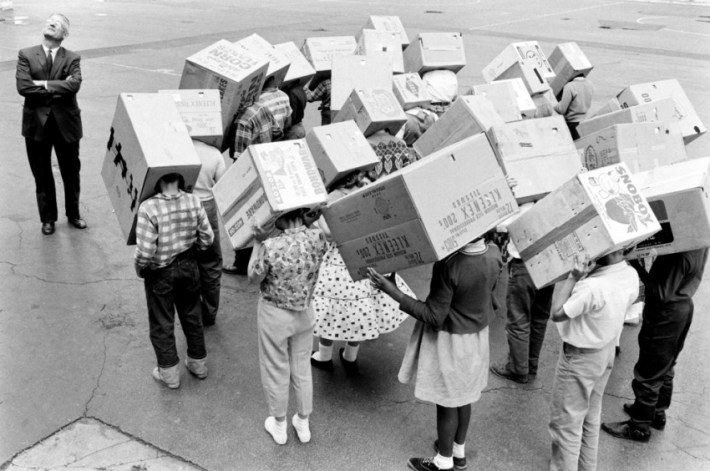
I neglected to get a pair of special solar eclipse glasses for Monday’s big event so Sunday evening was spent franticly scrounging in my basement for a sturdy cardboard box to use as an alternative protective device.
It had served me well in 1963.

Life Magazine 1963 Instructions for protecting yourself for the Total Solar Eclipse July 20 with a sunscope.
While some kids borrowed their parent’s Foster Grant sunglasses to stare at the eclipse, for my first ever total solar eclipse on July 20th, 1963 I donned a “Sardines From Norway” box over my head to look at the sun. It may not have been approved by NASA but it was given the A-OK by my second-grade teacher and by Life Magazine who demonstrated to readers how to safely look at the eclipse by creating a Sunscope, a pinhole camera-like contraptions that indirectly project an image of the sun.
My mid-century childhood eyes always seemed in danger.
Fear of blindness seemed to loom over me. Sitting too close to the TV in a dark room would ruin your eyes permanently leading you down a dangerous path that ended with you selling pencils on the street. Of course, you could also shoot your eye out with a Red Ryder BB gun, or stab your eye by running with scissors causing blindness.
But the most dangerous of all was staring at a solar eclipse.
Somehow a cardboard box would save me from that fate.

Life Magazine 1963 Instructions for protecting yourself for the Total Solar Eclipse July 20 , with a sunscope.
In the final week of school that June, my last science project in second grade was to make a Sunscope in anticipation of the summer’s major event the Total Solar Eclipse.
My teacher Miss Custer had taken her cue from Life which ran an article offering tips on how to construct one using the example of a fifth-grade class in Illinois.

Life Magazine 1963 Instructions for protecting yourself for the Total Solar Eclipse July 20. The teacher explains the science behind the Sunscope.
During the solar eclipse of 1960, hundreds of people suffered permanent eye damage from looking at the sun.
Something had to be done.
Now in the space age of 1963, there was a solution. With the help from the Illinois Society for the Prevention of Blindness, fifth-grade students at an elementary school in Maywood Illinois avoided the same fate by building sunscopes. The magazine offered step-by-step instructions for those wanting to make the project at home.

Life Magazine 1963 Instructions for protecting yourself for the Total Solar Eclipse July 20 , with a sunscope
A final word to the wise from Life “Don’t forget to come out for fresh air.”
The Eclipse-O-Scope
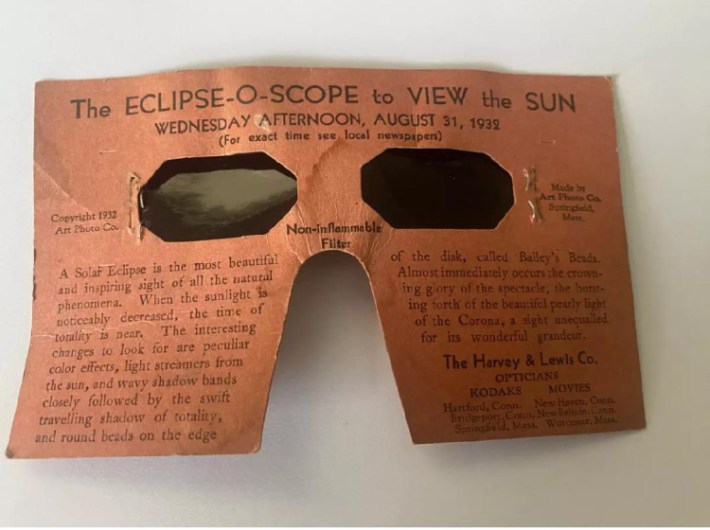
The Eclipse-O-Scope to view the Sun safely August 31,1932
Always worried about my eyes, my mother wasn’t convinced of the effectiveness of a cardboard box for viewing the eclipse and went rummaging through one of her many junk draws until she came across what she was looking for.
Buried among old receipts, a 1939 World Fair Pickle pin, and an old ball of red and white bakery string, she found what she was looking for.
Her very own “Eclipse-O-Scope” that she used as a 6 six year to view the Total Solar Eclipse of August 31, 1932. Her family had driven to Vermont that summer for the occasion, armed with the hi-tech glasses made by Kodak. These cardboard stock frames with “lenses” of darkened celluloid were made for safe viewing.
The Eclipse Was No Laughing Matter

As the momentum for the eclipse came closer, I preferred to take my reliable eclipse advice from the newspaper.
The comics actually. Peanuts specifically.
Charlie Brown and the gang offered their own sound advice for eclipse watching explaining it over 5 days from July 15- 20th.
Linus demonstrated a safe way of absorbing the eclipse as opposed to looking directly at the eclipse. On the day the Eclipse passed over his area, Linus was left helplessly standing in the rain with cloud cover entirely too thick to witness the eclipse.
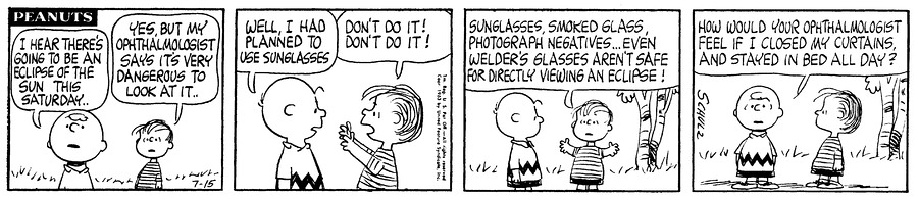 July 15, 1963
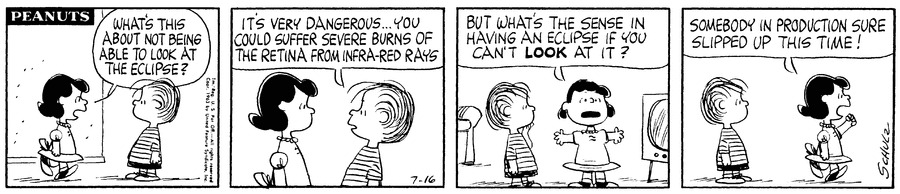 July 16, 1963
 July 17, 1963
 July 18, 1963
 July 19, 1963
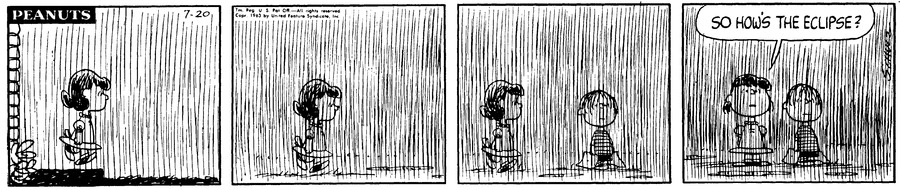 July 20, 1963



 Envisioning The American Dream
Delightful.
LikeLiked by 2 people
Glad you enjoyed it.
LikeLiked by 1 person
There was an eclipse in 2017 that was 100% over my town. People came here from many states, Canada, and other countries to view it.
Over 270 people flew in in private planes, creating a plane parking lot so large at the local airport, the local police and highway patrol had to stop traffic of lookers curious to see so many planes gathered at the airport where only one plane comes twice a day for commercial flights.
I only had to step outside my front door and view it with a friend, a couple from Denver, and another resident on the next lane. My friend and I sat in the back end of my VW Golf SportWagen to watch.
When my friend tried to return home to Rapid City, South Dakota, a trip that takes 2:30 on normal days, it took him 5:15 after he joined the north-bound traffic after the eclipse! There was an 1:15 mile from the intersection of Box Butte Avenue (main street) and 3rd Street leads to the intersection of 3rd Street and US 385 North.
On US Highway 385, a 65 mph speed limit, he had to drive 35-40 mpg from Alliance to the South Dakota border, typically a bit over an hour at speed limit.
Though the speed limit goes to 70 mpg at the South Dakota border and the highway becomes a divided four lane, traffic continued to be very slow and bumper to bumper!
On top of the eclipse traffic, the RV traffic in late August means lots of vacationers in slow vehicles already were on the highway in South Dakota, adding to the confusion and congestion. There was an accident 57 miles south of Rapid City at the Hot Springs turnoff that added an hour’s wait to my friend’s trip. which he said he was able to drive 55 mph to 70 mph on the 70 mph South Dakota road north.
I think you are in the 100% zone this time, so hope you have no place to go for a few hours before and after the eclipse! It will be a mad house for you and people do come out for them!
We had the added attraction in Alliance of the folk-art roadside attraction, Carhenge, that brought out the “Druid” crowd, people with quirky senses of humor, and ABC News. Though the sky was a bit overcast before the eclipse, it cleared in time for the event, then went back to overcast. Whew!
The smart people were a carload of Native Americans from South Dakota who stopped a mile south of Carhenge on a country road where the crowd and Carhenge could be seen but hadn’t the sense to do what these people did: take out a picnic, set it on a blanket, and enjoy the scene without a crowd! My friend and I waved at them, they waved back, clearly having enjoyed the eclipse as they were in a very good mood! My friend noted that on the trip back home, many people waved their own greeting with a middle finger.
I tried to talk my friend into taking a country road back to town, but he insisted on going by highway, which had no entry north or south because people were going both ways depending on where they came from. It was the longest wait for me, but, as noted, just the start of long waits and slow traffic for my friend, who went home immediately…sort of… after the eclipse.
LikeLiked by 2 people
We are in a good location this time. I know there are towns that are really preparing for it and traffic has been crazy.
LikeLiked by 1 person