


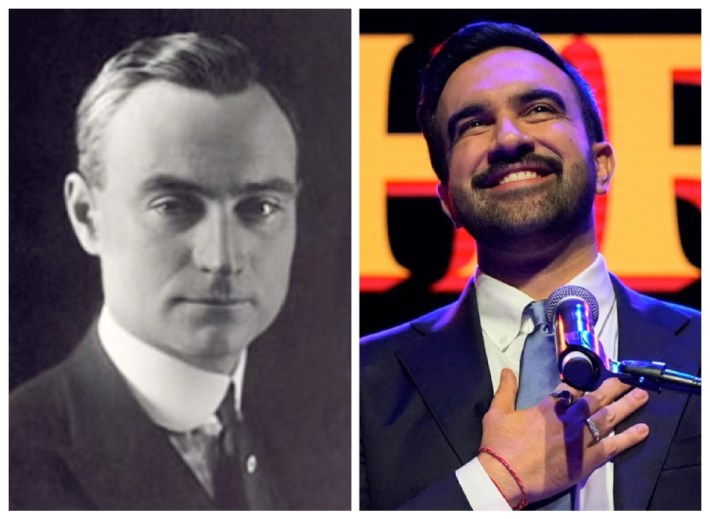
As the newly minted Mayor-elect of New York City, Zohran Mamdani can claim many New York City firsts.
First Muslim mayor, first mayor of South Asian descent, and first Democratic Socialist to run City Hall.
First Millennial Mayor?
Gen Z is convinced New York City never had a 34-year-old boy mayor before.
Well, at least not in over a century.
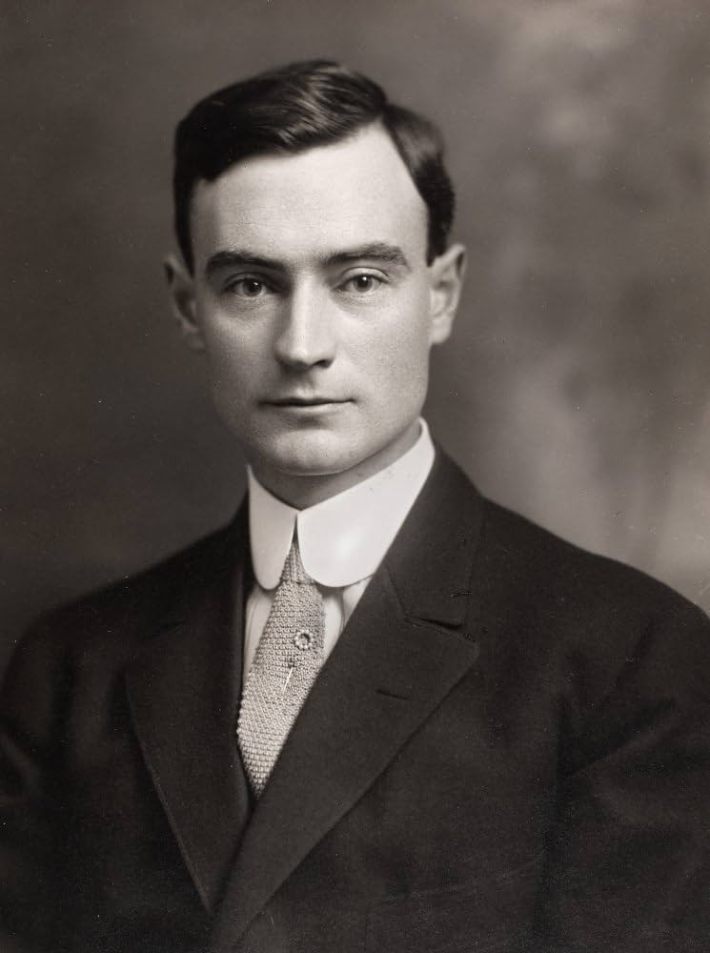
John Mitchel
The moniker of The Boy Mayor of New York has already been used.
That title belongs not to Mamdani but to John Purroy Mitchel, the baby-faced mayor of N.Y.C. from 1914-1918. Mitchel was a 34-year-old wunderkind when he was elected mayor in 1913 on the Fusion ticket, running on a reform, anti-corruption agenda.
Like Mamdani, he wanted to shake things up in city government.
And his background was as eclectic as Zohrans.
Born in the Bronx, he was of mixed heritage, with an Irish father and a mother of Venezuelan roots. Mitchell’s paternal grandfather was a prominent Irish revolutionary at a time when the Irish were scorned. His maternal grandfather, born in Venezuela, was the Venezuelan consul in N.Y., which made John Mitchel ostensibly the city’s first Hispanic mayor.
Mitchell became a symbol of youthful ambition in City Hall, earning him the honor of Boy Mayor.
My grandparents always referred to him as “The Boychik Mayor from the Bronx!”
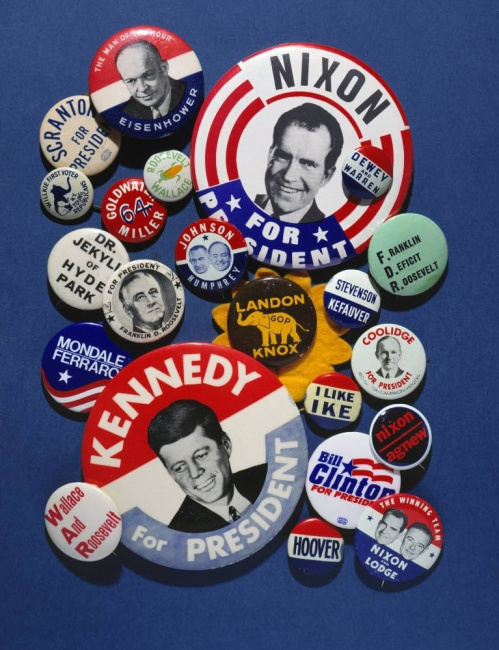
In my basement is a cedar cigar box filled with a jumble of dozens of old political campaign buttons. Nestled among the common “I Like Ike” and “Vote for Kennedy” buttons, and the more obscure “Clean House With Dewey” pins, is a single battered button declaring “John Purroy Mitchel for Mayor.”
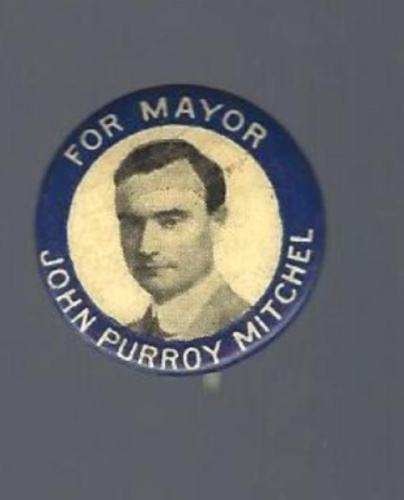
I found it several years ago while cleaning out my parents’ house in one of the dozens of “junk drawers” my mother kept. Like so many other collectibles in my mother’s possession that were often found buried among decades-old receipts, unidentified keys, rubber bands, and 1939 World’s Fair Heinz pickle pins this campaign button was stuck between two clipped coupons for Jello that expired in 1976.
This vintage 1913 mayoral campaign button likely ended up in my mother’s possession after the great clean out of my grandmother’s apartment after she died.

I recognized the N.Y.C. Mayor’s name immediately. It conjured up stories my Manhattan grandmother would tell me when I was a child exploring the city with her.
Weekend sleepovers at Nana Sadie’s West End Avenue apartment in the early 1960s were always a treat if not a cacophony of clamor, as demolition and construction on the Upper West Side was rampant under the bulldozer of Robert Moses.
Sundays in New York
Sundays with Nana were an interesting amalgam of her unusual multi-religious affiliations that just seemed part of a New York way of life.
The mornings always began bright and early, with a brisk walk to Zabar’s, a block away,y to beat the long lines to buy bagels and lox. After our breakfast nosh, a short subway ride on the A train took us up to The First Church of Christ, Scientist on 96th Street and Central Park West, where my grandmother was a congregant.
This imposing, landmarked church, built in 1903, was magnificent- a stately combination of English Baroque and French Beaux Arts detailing.
While my Christian Science grandma attended services in the large chapel with stained glass windows, I was placed upstairs in a Christian Science religious class. What my Jewish mother thought of this is hard to say. At least I sat with a belly full of belly lox to see me through the lessons of Jesus and Mary Baker Eddy.

When services were over, we walked through Central Park, strolling around the scenic reservoir. The stunning views of the skyline, beautiful in all seasons, made me fall in love with the city at such a young age.
On Fifth Avenue and 90th Street, we would always stop at a prominent, gilt monument at the stairway leading to the reservoir. A memorial to John Purroy Mitchel. This oversize gilded bronze bust over granite of the one-term mayor was dedicated in 1928.
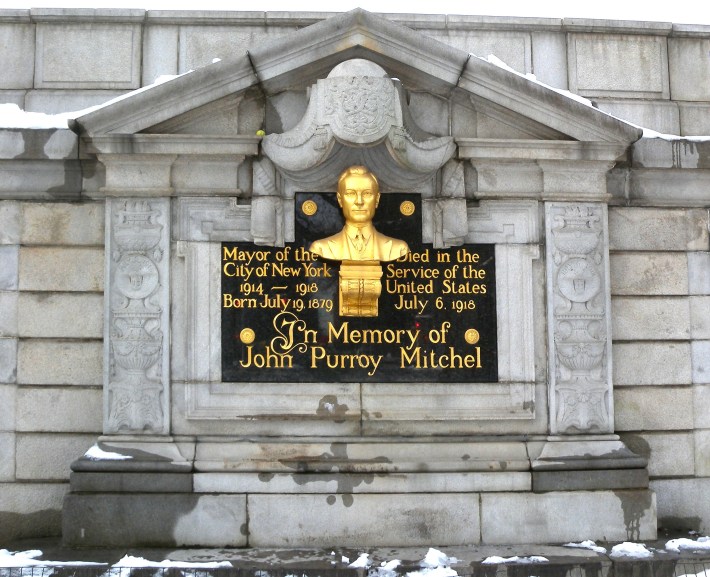
We would sit on the stone benches that flanked the monument and nibbled on some chocolate rugelach she had brought from Zabar’s that morning. Nana never went anywhere without a shopping bag of snacks. Tossing a few crumbs to the pigeons who had gathered around, she never failed to mention that John Mitchel was the only mayor honored with a memorial in Central Park. He still is.
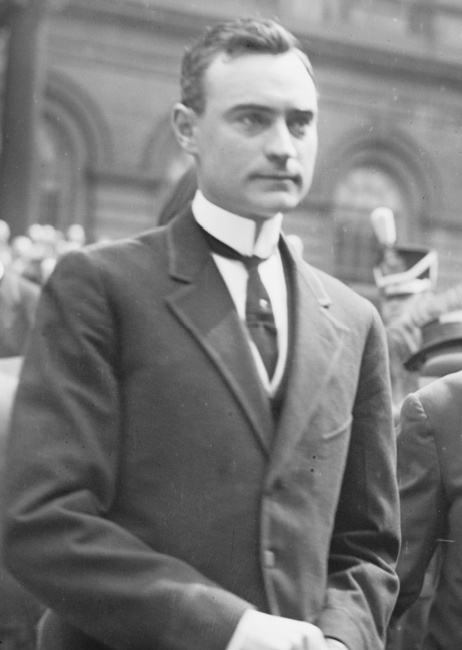
She explained that he was the city’s youngest mayor since the 1898 consolidation that added Brooklyn Queens, the Bronx and Staten Island to NYC to create 5 boroughs. I always found it hard to believe that her beloved Brooklyn had once been its own city.
This fresh-faced young man, who took on Tammany Hall, had won the election by the largest popular margin in the history of consolidated New York, but lost his bid for re-election in a heated wartime election.
As soon as he left office, he joined the army. In July 1918, while still training before being deployed to Europe, he fell out of his plane and was tragically killed at 38.
Though Nana Sadie had little memory of his time in office, it was his hero’s send-off she recalled.
The funeral was a major event.
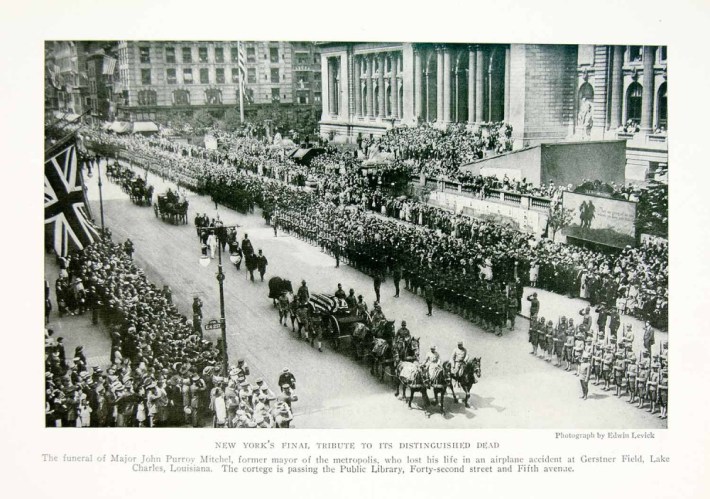
The City of New York turned out for the Boy Mayor’s funeral as it had not for his re-election.
It started with him lying in state at City Hall with over 30,000 people passing through to pay respect.
18-year-old Sadie and her schoolmates were part of the millions who lined city streets, from City Hall to St. Patrick’s Cathedral, silently witnessing the horse-drawn gun caisson that bore Mitchel’s flag-draped casket. Their numbers—larger than those mourning either Grant or Sherman—stunned observers. A squad of 20 planes dropped flowers on the mourners. Former President Theodore Roosevelt, who had been a big supporter of Mitchel, served as an honorary pallbearer.
No matter how old she got, my grandmother remembered saying goodbye to the boy mayor.
© Sally Edelstein and Envisioning The American Dream, 2025. Unauthorized use and/or duplication of this material without express and written permission from this blog’s author and/or owner is strictly prohibited. Excerpts and links may be used, provided that full and clear credit is given to Sally Edelstein and Envisioning The American Dream



 Envisioning The American Dream
You have such a knack for bringing history to life. I wish you and Sadie had been equipped with a smartphone camera to record your adventures.
LikeLiked by 1 person
I’m glad you enjoyed this. I’ve often thought of how different the recording of my childhood might have been if a smart phone existed. I am grateful to have the memories which remain firm, likely because I wasn’t distracted by using an iPhone.
Sent from Yahoo Mail for iPhone
LikeLike
What an interesting window into your childhood. Your Nana Sadie seemed to be a real original for her time. You were very fortunate to get to know the city in her company.
LikeLike
Along with my grandmother, I was fortunate to have many great Uncles and Aunts on bot sides of the family who all lived up and own Central Park West and so got to spend time in the city with them. Yes, my Nana Sadie was quite an original.
LikeLike
How lovely for you. My grandparents still lived on the lower East Side, on Grand Street. We used to visit them as a family for Friday night dinners, and sometimes on the weekends when my Nanny would fry up a heaping platter of latkes. The other relatives would come visit us on Long Island, so I never had that time wondering the city except with my parents and sister and brother.
LikeLiked by 1 person
That’s a whole other very interesting experience. You would be shocked at how hip and expensive the. Lower east dude has become bearing very little resemblance to visiting your grandmother. What a warm special experience that must have been.
LikeLike
Mamdani does have my ear, so I snicker to learn here about a previous boy mayor. Thanks for the info. A couple days ago, I drove past the original First Church of Christ, Scientist, now under construction as the future Children’s Museum of Manhattan. Your Nana sounds like a spitfire.
LikeLike
Ive heard about the plans for a future Children’s Museum and would love to visit when its completed. Nana was a charater for sure.
LikeLike