I am a collector.
I collect ephemera, old advertisements, newspapers, worn magazines, yellowing scraps of paper, the forgotten minutiae and stuff of everyday life that can reveal things we might not otherwise ever learn.
My home is a paper trail of my past, a repository of objects whose stories I feel compelled to preserve.
I come from a family of savers. Though I prefer to think of us as saviors, rescuing discarded fragments of the past from oblivion. We saved things. Held on to them. Tucked them away for safekeeping, sometimes long after they had outlived their usefulness.
But my family collected something else, too.
Secrets.
A boatload of them.
Secrets we kept from the outside world and secrets we kept from one another.
Locked Away
Like the objects that fill my home, I stored my secrets carefully, packing them away in the dark recesses of memory. Some were too painful to ever see the light of day. Others were wrapped in layers of shame, their contents too radioactive to reveal. But like toxic waste, the fallout from these could last for decades.
Buried beneath the accumulated debris of a life, one secret remained in storage for more than half a century.
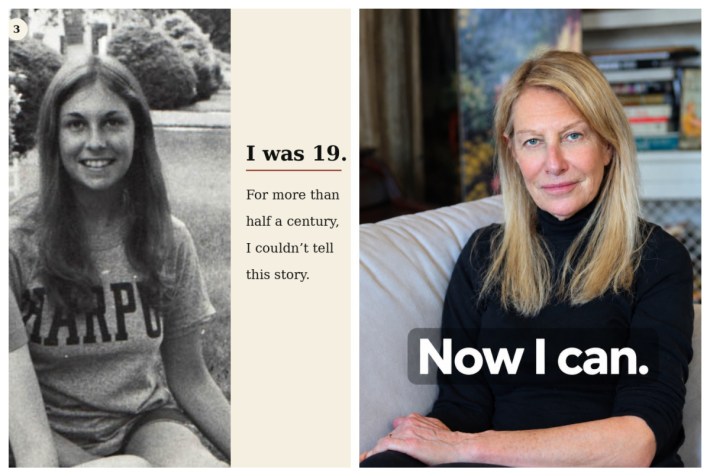
For 52 years, I held onto a story I could not tell.
52 years is a long time to keep something hidden. Long enough for an 18-year-old college girl to become a 71-year-old woman. Long enough for the world to change, for generations to come and go, for words that once couldn’t be spoken of to become part of our everyday vocabulary.
In 1973 when I was 18, something happened to me at a college fraternity that I could never speak about.
It was a time when women were being encouraged to embrace their newfound freedom, but the old rules of shame and silence remained firmly in place. Liberation might have been fashionable, but blaming women for what happened to them was a tradition that refused to go out of style.
So I packed the experience away. Tightly closed the lid.
Fifty-two years passed.
Then last week the news of the drugging and gang rape at a Cornell University fraternity broke through the protective layers I had so carefully constructed. Suddenly, the past wasn’t safely tucked away in some dark corner of memory. It spilled into the present.
I knew that girl. I had been that girl.
I began to think about all the other women of my generation who had grown up absorbing the same messages about shame, blame, and silence. How many were still carrying experiences they had never been able to speak about?
I wanted them to know they weren’t alone.
So I did something that ran counter to everything I had learned about keeping secrets.
I opened the box.
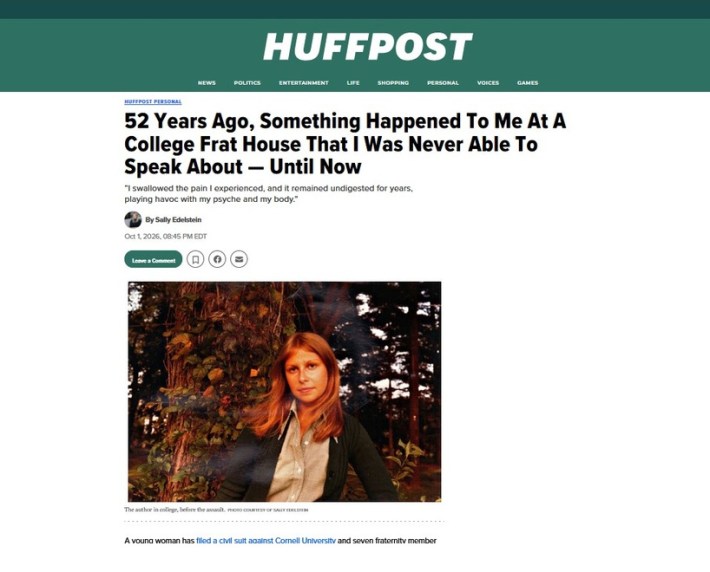
When HuffPost published my essay this past week about my rape at a Syracuse University fraternity, I felt as though I had taken something intensely private out of storage and placed it in full view. My carefully guarded secret was suddenly available to strangers everywhere with a click of a mouse.
The story traveled, appearing on Yahoo News and MSN, gathering readers and shares.
And then something extraordinary happened.
Reaching Out
I had hoped other women might recognize themselves in my words. I hadn’t imagined how many were waiting for that recognition. I had opened a door into a crowded room with women who had been waiting, sometimes for a lifetime, to speak
Hundreds of women began writing to me, often at remarkable length, entrusting me with deeply personal accounts of sexual abuse and assault. Some were strangers. Others were women I had known for years. Many were my contemporaries, women in their seventies and even eighties who had carried their own secrets through marriages, motherhood, careers, and entire lifetimes.
Their words were heartbreaking, intimate, sometimes hesitant. I recognized the silences between their sentences as clearly as the words themselves.
Their stories poured out in paragraphs. They appeared in comments on social media, in private messages and emails. I was struck not only by what they told me, but by how urgently they seemed to need to tell it. Decades of silence were finally finding words. Women who had been young in an era when shame so often fell on the victim were finally putting words to experiences they had locked away.
A New Collection
I had spent decades collecting fragments of the past, believing each artifact contained a story worth preserving. Now I found myself receiving another collection: stories that had never been given a safe place to exist.
I couldn’t change what happened to these women any more than I could change what happened to me, but I could listen; I could bear witness. Darkness becomes less isolating when we discover we are not alone in it.
Perhaps that is what it means to light the way for others. Not to illuminate every dark corner or promise the darkness will disappear, but to hold a light steady enough that someone else feels less afraid to step forward.
My heart was my torch. I found compassion can illuminate places that shame has kept dark. One woman’s willingness to speak can give another the courage to find her own words. Compassion gave me the courage to carry it into a place I had feared entering for more than half a century
And if that small flame helps another woman find her voice, then perhaps the light I carried out of my own darkness can help illuminate a path for someone else.
I used my voice so others could use theirs.