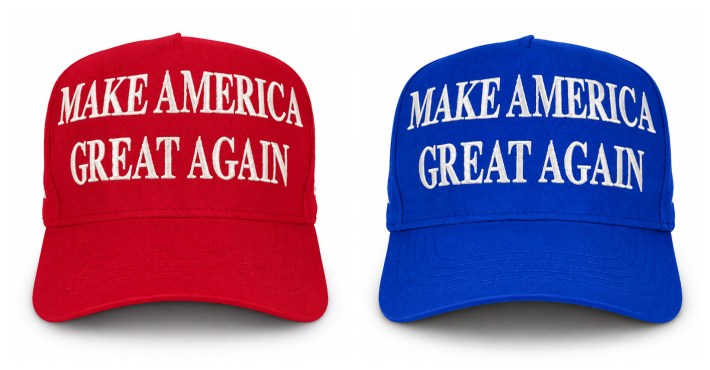
My husband was just about to take our dog Moe on a walk when, out of the corner of my eye, I noticed the cap Hersh was wearing. Without blinking, I quickly snatched it off his head.
“No more Red Caps!” I screeched in a voice worthy of Joan Crawford in her infamous tirade against wire hangers.
Despite this being a 20-year-old cap bearing white type for an oyster house in Cape Cod, its resemblance to the infamous MAGA one was too close for comfort.
Especially so close to elections.
In a neighborhood whose lawns are littered with Republican red cardboard campaign signs, any visual sign that could be seen as support is off limits.
Though I like to think of myself as being color blind, when it comes to politics I’m true blue. Praying for a blue wave, just the thought of political maps awash in red on election night sends shivers down my blue state spine.
Today it’s almost universally accepted by Americans that there are blue states like New York and red states like Texas. That Republicans are “red” and Democrats are “blue.” These colors are so ingrained in our sensibilities as part of an identity as Republicans or Democrats.
It would be reasonable to assume these must be the official colors of these two parties and have been used for over a hundred years, right?
Nope.
Republicans haven’t always been associated with the color red, nor have Democrats affiliated their party with Blue.
In fact, the whole notion of consistently attaching a particular hue to each political party is a relatively new concept in the U.S.
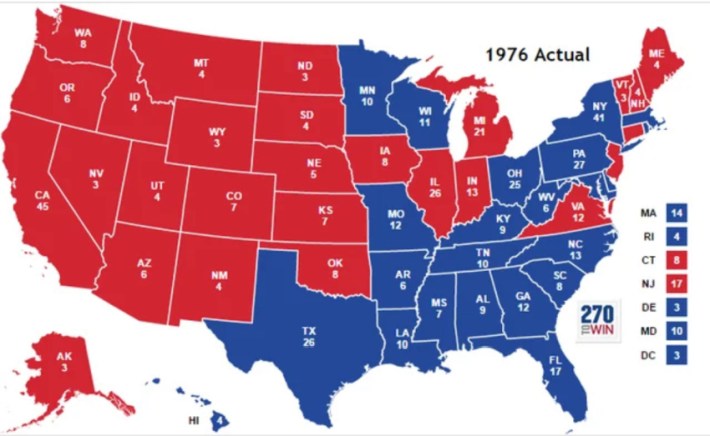
In 1976, when NBC’s first-on-air election map lit up blazing with red, I was ecstatic. It was my first presidential election, and I had picked a winner.
Democratic candidate Jimmy Carter.
Blue and Red originally had nothing to do with the parties.
NBC debuted the first full-color electronic electoral map on TV, and chose blue to represent the incumbent party and red to represent the challenger. In that year, the Republican Party was in power, so the “blue states” were the states projected to go to incumbent Gerald Ford, and the “red states” were projected to go to Democratic challenger Jimmy Carter.
As election results flowed in on the night of November 2, 1976, lightbulbs in each state lit up, changing from undecided white to Republican blue and Democratic red.
The same year, ABC News used a small version that used yellow for Ford, blue for Carter, and red for states in which votes had yet to be tallied.
When Nobody Could Agree on a Color Scheme
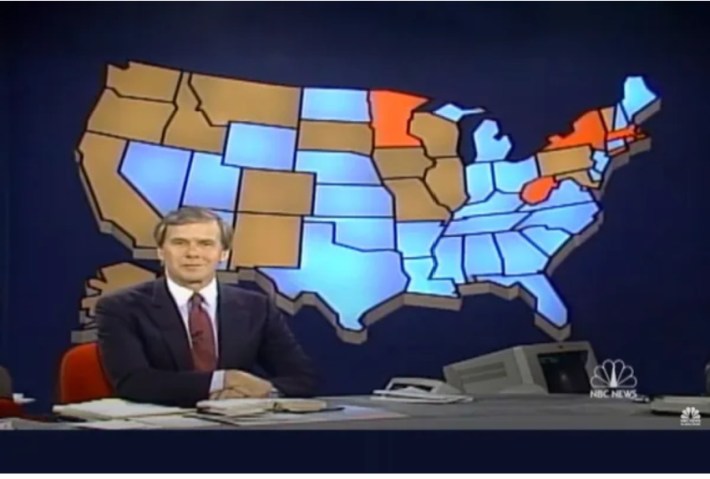
NBC News 1988 electoral map marked states by Republican George H.W. Bush in blue and states won by Democrat Michael Dukakis in red.
The feature proved to be so popular that, 4 years later, all three major television networks used colors to designate the states won by the presidential candidates, though not all using the same color scheme.
So, depending on the election or the network, red and blue were variously assigned to Democrats and Republicans. There was no uniformity in the maps that TV stations, newspapers, or magazines used to illustrate presidential elections.
Ronald Reagan Blue
NBC newsman David famously referred to the 1980 election map outcome showing Republican Ronald Reagan’s 44-state landslide in blue as resembling a “suburban swimming pool.”
Reagan’s landslide victory painted the map almost entirely blue, which is a strange thing to picture now, given how thoroughly Reagan became the patron saint of the red party
The notion that there were red states or blue states and that the former were republican and the latter democratic wasn’t ingrained in the national psyche until 2000.
The colors representing incumbent vs. challenger being different across the networks continued up until the 2000 election, when the results between Bush and Gore were disputed.
As different TV networks (and the printed publications citing them) were referring to different “red states” and “blue states” on their maps, it created a lot of confusion, resulting in the media outlets eventually deciding to be consistent in their map coloring.
They agreed to use NBC’s original color scheme: blue for incumbent, and red for challenger.
At that time, the Democrats happened to be the incumbent party and the Republicans were the challenger.
Two Americas
By the 2002 midterms, journalists were already writing about “two Americas: red and blue” as though the country had sorted itself into two coherent cultures overnight.
“Blue state” and “red state” had become so synonymous with “Democrat state” and “Republican state” that, by the 2004 elections, the original incumbent/challenger coloring scheme was tossed out in favor of leaving them as Democrat/Republican, and the colors have remained as representing the parties ever since.
By then, the vocabulary was everywhere, carrying connotations that nobody had assigned it on purpose. Red became associated with rural America, the religious, the South and the interior West; blue with cities, more secular population, the coasts and college towns.
Now red has become the symbol of conservatism and intolerance. As an accident of media history, the current colors are evidence of the randomness and instability of political color codes.
But for now I still draw the red line at red caps.