


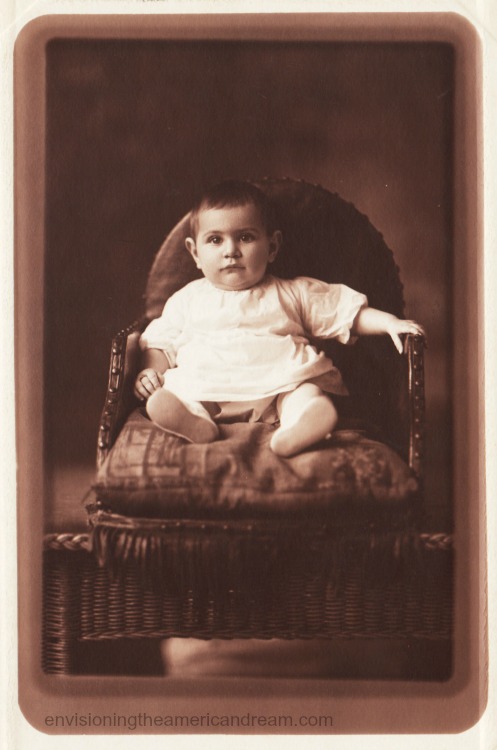
In 1926, while flaming youth roared and thousands mourned the death of Rudolph Valentino, my grandparents, Sadie and Arthur Joseph, were overjoyed at the birth of their second daughter, Betty Francine, my mother.
Always a joyous Bastille Day Birthday, this jazz age baby would have turned 100 today.
This sepia-toned photograph and the baby it documents are now a century old. Mounted on thick cream colored board, and embossed in gold on the back is the name of the photography studio: B. Bloch 543 Fulton Street, Brooklyn.
Today, holding this well-preserved one-hundred-year-old picture in my hands, a whole story unfolds in my mind of the day this photo of my future mother, Betty, was taken.
Unlike today’s iphones when we can effortlessly capture every nuance of a baby’s life, a formal baby portrait was a special occasion. And it required patience.
Mr B. Bloch knew when to release the shutter.
A Baby is Born
In July of 1926, while mother and newborn baby were rooming together at Mt Sinai Hospital in New York for the standard 14-day maternity stay, her husband, my grandfather Arthur, got down to practical business.
Making an appointment for Betty’s official baby portrait.
An amateur shutterbug, Arthur wanted the best for Betty, and B. Bloch was the man. This popular, well-established studio in the heart of downtown Brooklyn had been well respected since the late 19th century and was often booked months in advance. Arthur made the appointment for late autumn.
The studio located on bustling Fulton street Brooklyn, not far from A&S Department Store is already alive by 10 o’clock that November morning when the Josephs arrived in a taxi from their home in Crown Heights. The electric trolley cars were clanging their bells, the autos honking, the elevated train rumbling overhead, its steel wheels producing a familiar metallic roar.
After walking up a flight of polished wood stairs, they stop at the frosted glass doors with the Bloch name in elegant gold script.
In the well-appointed waiting room, decorated with Persian rugs and dark oak wainscoting, the family settles into the soft upholstered chairs with carved walnut arms.
Adjacent to them stands a large mahogany cabinet displaying dozens of mounted portraits and silver trophies from photographic exhibitions. Sadie scans the cream-colored walls filled with dozens of framed pictures, all beautifully lit, of young women graduating from Erasmus Hall High School, soldiers from the Great War, college graduates, and a bride holding lilies.
It could be Betty’s future laid out in photos.
Mr B Bloch

Mr. B Bloch, a distinguished gentleman wearing round spectacles, his gray hair carefully brilliantined, comes out to greet them, ushering the family into the studio.
The portrait studio is astonishingly bright. A skylight spans much of the ceiling, and the daylight is soft and slanting. Electric Mazda incandescent studio lamps stand at the ready.
It is hard to tell who was more captivated by the sights, baby Betty or her father Arthur.
My grandfather’s eyes light up, immediately drawn to the camera that dominates the room. An enormous 8x 10 Eastman view camera of polished mahogany mounted on a heavy Century Studio Stand. Brass controls gleam in the light, and the enormous bellows extend nearly two feet.
Arthur silently notices the simple backdrops now considered sophisticated. Unlike earlier baby portraits, there are no elaborate props like painted gardens, lace curtains, painted castles, or sentimental accessories. Everything is understated, with simple textured backdrops.
The photographer wanted the viewer’s attention on the subject herself. Nothing should compete with the baby.
Baby Betty Is Ready For Her Close Up
Betty was dressed simply, no bonnet, no lace, or oversized ribbons, and was seated on a wicker chair, intended for babies and toddlers. Plopped down, she sits on an enormous cushion overstuffed so the baby would sink ever so slightly, preventing her from sliding forward.
The photographer waits until she is settled naturally, rather than in a forced pose.
Very few babies smiled in photographs before the 1930s because exposures still required some stillness. Instead, Betty is looking calm and curious, almost evaluating the photographer. There is a dignity in that expression, and she is treated almost like an adult sitter.
The photographer recognized it. Instead of making her laugh, he photographed her exactly as she was.
It was all about waiting. Nothing happens quickly. Photography in 1926 is an act of observation rather than capture.
A Moment Captured For a Century
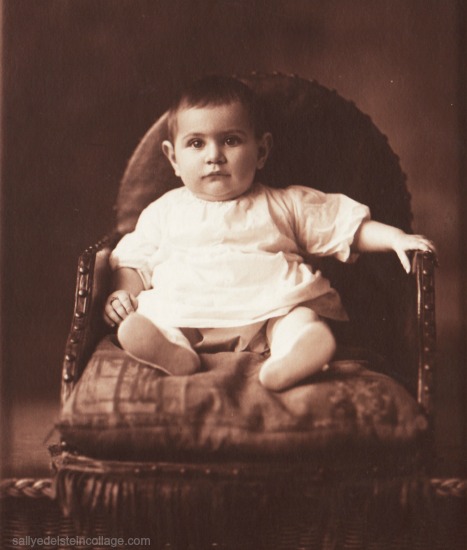
My future mother Betty 1926
Bloch watches her for several minutes before even uncovering the camera. The room is warm from the steam radiator that hisses softly as steam cycles through the pipes.
Then Mr Bloch disappears beneath the black cloth, studies the upside-down image while you hear only his voice from inside.
He slides a film holder onto the back of the camera. Removes the dark slide. There is a pause everyone is silent for perhaps 3 seconds.
Betty’s eyes drift toward the camera lens. For one brief moment, she looks directly into the camera. Not smiling, simply curious. Observant. It is an expression impossible to manufacture and an expression I would recognize in my life with her. Bloch gently squeezes the rubber bulb attached to the shutter release.
A nearly inaudible click.
One eighth of a second and a lifetime preserved. To be held in her daughter’s hand a century later. Shared on the internet in one hundred years.
Bloch smiles with the satisfaction of experience. “I believe,” he says, sliding the film holder from the camera, “your daughter just made a very fine portrait.”
Afterwards, there is no instant result, no preview. The negative disappears into the darkroom. Nothing can be seen yet. My grandparents trust the photographer’s confidence.
Before they leave, Mr. Bloch shows them samples of embossed presentation folders and mounted prints. They order several prints for grandparents and aunts. The order is carefully handwritten into the ledger. The finished photograph will be ready in about 10 days.
A Moment in Time
The picture captures a child born into the optimism of 1926. The portrait is more than a family keepsake; it stands at the threshold of an era.
Smack dab in the middle of the roaring twenties, eight years had passed since the end of the Great War, and Americans were ready for fun. Our president, Silent Cal was keeping mum as the economy skyrocketed. Consuming goods as never before, folks were running down to Florida in get-rich-quick schemes, while Miss Texas Guineas, the boop-boop-de-doop speakeasy girl, beckoned us “to live it up.”
Now, looking back a century later, we know the history that lies ahead. That Betty does not. That quiet, direct gaze embodies the innocence of a moment before the upheavals that would shape the rest of the twentieth century.
In retrospect, knowing the upheavals that would follow, the Great Depression, another World War, and the Cold War, the moment becomes poignant.
Inside the studio, time has briefly stood still.
A few seconds of light were fixed onto a sheet of film, preserving not only the likeness of my future mother, Betty, but also a family’s confidence in the future, their faith in the American promise.
I cherish this picture as I cherish my mother. Today and always.
© Sally Edelstein and Envisioning The American Dream, 2026. Unauthorized use and/or duplication of this material without express and written permission from this blog’s author and/or owner is strictly prohibited. Excerpts and links may be used, provided that full and clear credit is given to Sally Edelstein and Envisioning The American Dream with appropriate and specific direction to the original content.





All the little details in your stories of the past really bring them to life. This is a beautiful tribute to your mother and her parents. It was so enjoyable spending time with them in the Brooklyn of 1926.
LikeLiked by 2 people
Thank you Riva, I am so glad you enjoyed this. I wanted to feel and imagine what that day was like. When we look at old photos there steals do many stories we will never know. Now I do.
LikeLiked by 1 person
Your story is so vivid, heartwarming and masterfully written. Betty is so proud of you.
LikeLiked by 1 person
Thank you so much . I know my mother would have enjoyed it immensely.
LikeLike